Monday, March 06, 2006

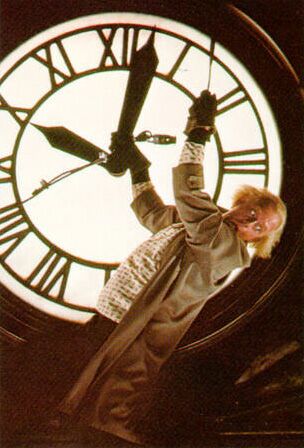
Back to the Future


Axel and I were watching the German possible-worlds scenario film Run Lola, Run when we got to thinking about time-travel. Naturally, our discussion required that we accept a common sense, spatialized conception of time, if only to give the screenplay writers a fighting chance; reading Bergson and listening to Elusive-Hyphen's diatribes against "Hollywood's obsession with time-travel" made this fairly difficult.
Axel's opening view was that, if we accept a strong determinism, then it is not inconceivable that our irruption into the causal chain, when we go back in time, is always already part of the 'causal account'. That is to say, our actions as a time-traveller in 1975 would be determined, but determined by states of affairs in 2006.
I objected by saying that, given our assumptions (ie, our commonsensical, simple-science fatalism), a problem arises because, from these very assumptions, it follows that the state of affairs in the world at any moment is determined by that of the prior moment. And since on our simple model time unfolds in a 'straight-line', we encounter the same difficulty as Kant did on the question of free will: how does anyone, or anything, intervene in the causal chain, since causal determinism is true a priori (or in our case, by definition)?
To clarify - my problem with time-travel has to do with the magical appearance, in the causal order, of undetermined events, even though we know that they are determined by events in the future. To accept this outlook, we must adopt the view that all of history is simultaneous. The problem now is that our claim that 'every state of affairs is caused by the state of affairs immediately prior' loses all meaning, since we have no way in which to grasp such a temporal understanding of causality.

Our concerns developed from thinking about what would happen if you travelled back in time and murdered the 'young you'. Would the later 'you' simply evaporate? Would you find it impossible to kill the 'younger you'? These are pressing questions. But I think it is high time I recommend taking a look at Bergson ('how is forgetting possible?').

The shoe store

Listening to a lecture on Franz Kafka, I drifted off into reminiscences of the time I spent working in a shoe store. There were some characters: the second generation Pole whose only remaining outward signs of polishness were his blonde hair, and much-parodied tendency to pronounce 'a' like a 'u', as in 'Buttersea Bomber!' (his oft-repeated refrain).
Our assistant manager, part Moroccan, maintained a reassuring serenity, punctuated by moments of anger or jollity. His physique was notable for its slightly bandy legs (such as one might find on a cowboy).

Power/Knowledge

"I believe that anything can be deduced from the general phenomenon of the domination of the bourgeois class. What needs to be done is something quite different. One needs to investigate historically, and beginning from the lowest level, how mechanisms of power have been able to function. In regard to the confinement of the insane, for example, or the repression and interdiction of sexuality, we need to see the manner in which, at the effective level of the family, of the immediate environment, of the cells and most basic units of society, these phenomena of repression or exclusion possessed their instruments and their logic, in response to a certain number of needs. We need to identify the agents responsible for them, their real agents (those which constituted the immediate social entourage, the family, parents, doctors etc.), and not be content to lump them under the formula of a generalised bourgeoisie."
aaaaacontent to lump aajjaaaaMichel Foucault, 'Two Lectures', in Power/Knowledge p100-101.

Wednesday, March 01, 2006

Commentariat

Man, Colonel Chabert had me laughing into my keyboard with this comment:
"The longest threads on this site came from mocking or dissing someone's
favourite tv shows - its got to be the most unacceptable thing you can do. You
can abuse Palestinian militants or feminists or altermondialist actions all you
like, call them fascists working for the Man, but disrespect the television!
That's too far! Moralizing, killjoy...its really remarkable. Yet it's not hard to
find out what every hour we each spend in front of the tv is worth to the
Masters. So the radical refusal of destructive, market greasing activity will be
put off indefinitely, while the radical refusal of constructive action will
remain the default position, as ever...."
Guilty as charged guv: when I do have a tv in the house, I can't resist a bit of 70's film action ('twas Smokey and the Bandit last sunday - diamond).

Colloquium

I've spent the evening at the expense of the philosophy department, in the company of a fairly eminent French thinker (as a clue to his identity, we can say that a dumbass nouveau philosophe might call our man a 'deckhand on the ship of fools').
During his talk, he spoke about Masoch, and how Deleuze, in breaking up the sadist-masochist unity, articulates an account of masochism which is deeply subversive. At dinner, he distinguished himself as uncompromising, yet warm. He returned the wine, and left most of his meat untouched; delicate french tastebuds recoiling from Coventry cuisine.

Unfortunately I was a little too overwhelmed to have anything interesting to say to him. I felt less like an interlocutor and more like an anthropologist (see this rare species! a genuine thinker! what books does he read? what films interest him?)
When I did talk, I expressed an interest in attending a module based on his current research, rather than him regurgitating old Mademoiselle Plateaux material - a remark which seemed to impress him. I, in turn, was impressed when he explained why he teaches in England ('it is a question of deterritorializing...', 'they let me do what I like...') .

Otherwise, there was department gossip, but I refuse to report it here, since I am trying to kick the habit. I have something of an antipathy towards forming a 'continental bloc' - I would rather simply commit a grievous bodily harm offence against the person in question. Of course, my concern is that, once in prison, I will be compared less to causes célèbres Negri and Genet, than to Schlick's mad student murderer...

A project

What would you say if I told you I was (physiologically, rather than psychologically) addicted to a certain substance, even though I have never ingested that substance?

Tuesday, February 28, 2006

Tuesday love

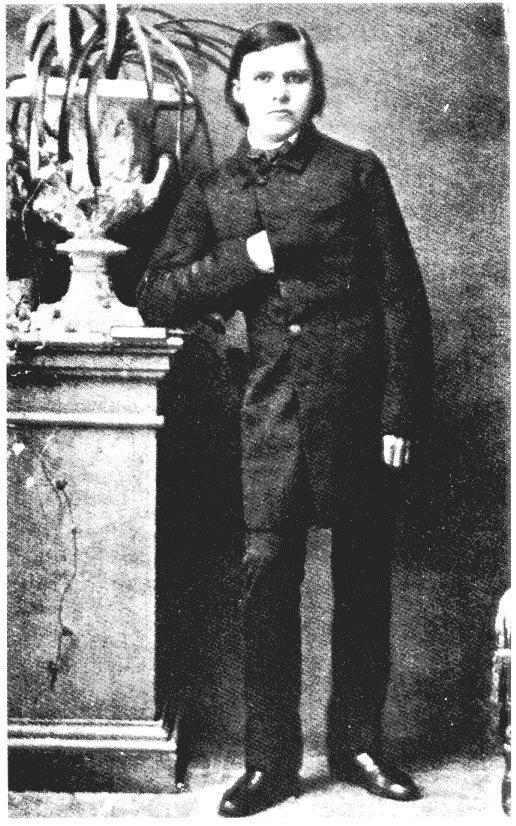
Here are two pieces of music composed by Friedrich Nietzsche. For now, I shall say that I love them insofar as they exist and can be listened to, rather than insofar as they are masterpieces.

The first: "An early Allegretto for piano, on which Nietzsche worked off and on from 1858 until it found its final form during his Leipzig study period. In it, Nietzsche used Beethovenian material, which becomes particularly apparent in the slow passage in the last third, which is reminiscent of the so-called 'Moonlight' sonata. In this recording, you can hear Michael Tannenbaum in a concert at the Evangelical Academy at Hofgeismar, Hessen, which took place there on October 28, 2000" (thanks to Nietzsche and Music).
The recording doesn't sound too good, but we shan't let that bother us.

From the same site, we have another piano piece: Hymnus an die Freundschaft (1874), written for his friend Franz Overbeck. Later he adapted the hymn to be performed with Lou Salomé's poem Prayer to Life.

Monday, February 27, 2006

A caffeine-induced state of mind

Such wonderful feelings I had last night at around three. I was sitting in the living room, Bach Cello Sweets (taste the sad) unfolding in the background, with a small cup of espresso in my belly. I was reading Essai sur les données immédiates de la conscience, and it was going smoothly.
I thought back to Sartre, sitting somewhere in Paris, 82 years ago. His eyes passing over the very same forms that were before me on the page.
I thought, along the lines of Beauvoir's attempt to become a coat by concentrating on it hard enough: 'if you immerse yourself completely in the sentences, dogmat, if you allow the words to fill your consciousness, you could be Sartre!'

Sociality

"You're just saying that cos Elusive-Hyphen was making fun of Heidegger and Wittgenstein in his lecture the other day!"
How not to make friends in philosophy. Luckily, I was talking to Mon and P, so it was more a question of 'how much can I alienate these two lovable lads?'

P is getting in the habit of telling me to "stop taking cues from M," which is becoming(-?)irritating since I don't believe he realises the extent to which my views differ from M's.
Speaking of whom...

M introduced me to a friend of his, who gave me an easy ride until 10pm, then asked "what is your relation to women?" Uh-oh. I am not effusive on this topic at the best of times, let alone around someone I'm trying to impress through an (over)use of thoughtful silences.
She had found me lacking in character, a defect I tried at once to deny and defend. That was foolish.
"I'm not so-and-so, and if I am it is only because of such-and-such," I crumpled.

Friday, February 24, 2006

Small alterations

As you may have noticed, there have been a few changes round here. I hope you enjoy the new look (which may well be tinkered with over the next days).

Thursday, February 23, 2006

Formfilling


What a fun day! I met two of my lecturers to discuss my year-essays. For Dr Ampere, I shall be working on late Lyotard and the sublime, which will involve investigating the Levinas connection. We also discussed next year's modules, and he gave encouraging signs (I naturally get excited when the words 'Foucault', 'philosophy' and 'module' are mentioned in the same breath).
Elusive-Hyphen steered me away from a 'Bergson vs Sartre on freedom' essay, towards a Bergson and Merleau-Ponty comparative work. This is a project to which I am especially looking forward, since I am itching to investigate properly what distinguishes Bergson from phenomenology. Plus I can't wait to carefully and painstakingly describe 'the Image' in all its shimmering beauty.

Wednesday, February 22, 2006

Artists and philosophers

"Through having reached the percept as 'the sacred source,' through having seen Life in the living or the Living in the lived, the novelist or painter returns breathless and with bloodshot eyes. They are athletes - not athletes who train their bodies and cultivate the lived, no matter how many writers have succumbed to the idea of sport as a way of heightening art and life, but bizarre athletes of the 'fasting-artist' type, or the 'great Swimmer' who does not know how to swim. It is not an organic or muscular athleticism but its inorganic double, 'an affective Athleticism,' an athleticism of becoming that reveals only forces that are not its own - 'plastic specter.' In this respect artists are like philosophers. What little health they possess is often too fragile, not because of illnesses or neuroses but because they have seen something in life that is too much for anyone, too much for themselves, and that has put on them the quiet mark of death. But this something is also the source or breath that supports them through the illnesses of the lived (what Nietzsche called health). 'Perhaps one day we will know that there wasn't any art but only medicine.'"
Perhaps one day we will know that perhapsll hlealthFelix and Gilles, What is Philosophy.

Grauniad: corrections and clarifications

"Our obituary of George Psychoundakis declared that his memoir, The Cretan Runner, was translated "with inimical lyricism" by Patrick Leigh Fermor. Inimitable, we meant."

Friday

There was a party on friday night. At Hades and B. It was fun, though I did go around - in a rather higgledy-piggledy fashion - telling everyone why a dose of Nietzsche makes radicalism so much more fun.
Hades and I considered the ways in which the appearance (or name, etc) of a thinker affects the extent to which we open ourselves to their thought. Hades began by saying that he took an instant dislike to David Hume, because he hasn't a nice name. We agreed on the need to complicate this, since A.N. Whitehead has possibly the ugliest name in philosophy, and yet his late works make him seem marginally interesting, enigmatic, and cutting-edge.
I put forward that old favourite of mine: that it is possible to gather a lot about someone not by their looks but by their countenance, their bearing, their facial expressions, the way in which they hold themselves, and the 'look' on their hands. This view was bolstered, I thought, by an interview - which I saw last week - with Francis Bacon. Up 'til that point, I had only ever seen still photographs of him (ok, and self-portraits, but that is another matter). Frankly, his face repulsed me, in an astonishingly powerful way. Yet when I got to see it animated, talking, quaffing red tea, I fell in love with that face.

Tuesday, February 21, 2006

Tuesday Love

Isn't it marvellous that the study of philosophy allows room for quaint anecdotes about doddering old men? Dr Ampere regaled the class with tales of his neighbour, "who must be about ninety," going for his daily walk with the regularity of a metronome and the grace of a gnome. What's more, this wasn't just to pass the time, but served to illustrate Deleuze's Bacon.

I also love the ineptitude of The Times hatchet job on P.F. Strawson and analytic philosophy. Two wrongs don't make a right - newspapers pissing on Strawson's grave is not going to make forgetting the Derrida obituary fiasco any easier.

Friday, February 17, 2006

Come on baby, do the locomotion


I was cycling onto campus this morning, when I saw a man with a camera standing on the footbridge which crosses the railway line. A real live trainspotter! What a treat. I observed him closely as the time came. The eye of the duck, we might call it.
Along the track, I saw an unusual looking engine approach. Ah. Our anorak raised his camera, poised to strike. At this very moment (Richard Branson bless his heart) a Virgin Trains express hurtled past, completely blocking any view of the old locomotive. To his credit, the trainspotter remained calm, looking deadpan.

Thursday, February 16, 2006

Wednesday, February 15, 2006

Attack of the Killer Bees


I found this strange 'game' - it involves directing a swarm of bees around a badly characterised cityscape. Endless hours of joy. Here.

Tuesday, February 14, 2006

Dogmat strays

I have been asked to contribute to a collective blog. 'An honour', I said. Now, those of you familiar with what I write here will not be unjustified in thinking "what the fuck, dogmat?"

"What the fuck" indeed. Seeing as the blog to which I shall be contributing draws some inspiration from Deleuze and Guattari, this might be confusing. I do not wish to go over what I have already said regarding these thinkers and the reading of them, here and here. Rather, I shall say that I hope to be involving myself in something unusual and interesting, and possibly even exciting.

Taking the brim_Took the broom is described thus:

"this group space of appreciation polemic_is Cabaret__positive interested___calL it enthusiasm_ poems, images, collage,audio theory of poems, Pop discourse of the same, lines of thought, a space_one desire-machine crossing the plane, crissing the other,plugging in,the transversality of verse, the metanoia of gloss and revision. 'Work' is defined as text,image either complete or in 'progress'__ Things mutate, everything transforms, metamorphosis."

Tuesday Love: cancelled due to foreseen circumstances

How can I talk about yes-saying on February 14. Millions of hearfelt words emanating from grotesque minds. No. Today, for one day only, I become a Nay-sayer.

Monday, February 13, 2006

It is a question of perspective

"He, I now reflected, [...] had always preferred the right-hand of the two salons at Sacher's café, as he would time and again maintain, because of the more comfortable chairs but primarily because of the much better paintings hanging there, I myself, because of the foreign newspapers, mainly the English and French papers, available there and also because of the much better atmosphere, actually preferred the left-hand one, and so we had, whenever I was in Vienna, whenever we went to Sacher's, and we liked going to Sacher's more than anything else, gone alternately to the left-hand and to the right-hand salon of Sacher's café, which in fact was better for our speculations than any other place, and hence the ideal one."
xcxxxxxxxplace,xxvvxxxxxxxxxxxxxThomas Bernhard, Wittgenstein's Nephew p97.

Friday, February 10, 2006

You're mad you are


A lethal cocktail of aspirin and vitamin C has induced in me a reckless mischievousness. I've been going around altering philosophy department announcements which should say "Nozick's attempt to solve the prisoner's dilemma" so that they read "Putznam's attempt..."
I took great effort to copy the handwriting, so it looks authentic. Now, I admit this jolly japery is a little bit 'culturally exclusive' (Seinfeld has been off the air for almost eight years you schmuck) but still, you don't have to be a New Yawk Jew to get the drift.
One day this kinda shit'll get me sectioned under the mental health act if I don't look out.

"Do you know what day it is, son?"
"Mus be 23 November 1963, sir. I remember clear cos I saw the newscast say President Kennedy got shot."

The corporate demon has climbed between the pages of my beloved books

I have been culling my books. Moving into a different room, I decided to cut my collection down to size. But it hasn’t been an easy process – I feel as if a small part of me has been lost forever.
Let me not get carried away. More importantly, we might wonder: ‘which part has been lost?’

Have you seen the latest fire hazard adverts? They feature the tagline: “You don’t have to die to lose your life,” accompanied by pictures of burnt sofas. Long gone are the days when vagabonds would stand in the street shouting “I’ve got my health and that’s all that matters!” Nope – nowadays you are your possessions. Throw my CD player away, and my soul is diminished. What happens if I get rid of all my possessions? Do I die? No. I die if I stop eating or drinking (but that is another matter: we all know what happens if you eat too much).

What has been lost in my book cull is a part of my consumer-self. Schopenhauer was right when he said that “the appropriation of a book is often mistaken for an appropriation of its contents.”

Tuesday, February 07, 2006

Tuesday Love


I love the way it feels a few minutes after taking painkillers. When I am sick - as I am now - they make me feel warm and contented. In fact, the sensation is washing over me at this very moment. Ah.

Monday, February 06, 2006

The weekend

I've just returned from a weekend away with the philosophy department. We stayed in a nice place in the countryside, and listened to papers in between eating and going for walks. On the first evening, I gave a short talk (students are encouraged to introduce and discuss a topic that they are interested in) about Bataille's economics. I presented Derrida's challenge - 'the gift is impossible' - and then tried to bring everything back together through the distinction between general and restricted economy. I attempted to explore the possibility of transposing aspects of one type of restricted economy (say, one based on potlatch) onto another type of economy - in our case, capitalist economy based on acquisition and accumulation. My conclusion? That the gift event and the theft event have the same potential for disrupting contempary modes of exchange. It was good fun, especially since I made sure to give an analysis of Bataille's apothegm: "the sexual act is in time what the tiger is in space."

As you can imagine, the primarily analytic audience just loved it.

Matches, in his talk, wondered why we don't all want to be short-sighted, two-dimensional egoists, if that means we get to be liked and have lots of money and possessions. Hmmm, that's something for all of us to think about. While waiting to transfer onto that MBA course.
On the final day, Mon introduced Tarkovsky's Mirror, which we subsequently watched. I thought it marvellous, but I definitely need to see it another two or three times. True to form, Matches was puzzled: "what was that all about?" Sigh.

Wednesday, February 01, 2006

"A certain evolution of wealth, whose symptoms indicates sickness and exhaustion, leads to shame in oneself accompanied by petty hypocrisy. Everything that was generous, orgiastic, and excessive has disappeared; the themes of rivalry upon which individual activity still depends develop in obscurity, and are as shameful as belching. The representatives of the bourgeoisie have adopted an effaced manner; wealth is now displayed behind closed doors, in accordance with depressing and boring conventions. In addition, people in the middle class - employees and small shopkeepers - having attained mediocre or minute fortunes, have managed to debase and subdivide ostentatious expenditure, of which nothing remains but vain efforts tied to tiresome rancor.
Such trickery has become the principle reason for living, working, and suffering for those who lack the courage to condemn this moldy society to revolutionary destruction."

having attaimmed Georges Bataille, 'The Notion of Expenditure' in Visions of Excess p124.

Dogmat on the slide...

Tuesday, January 31, 2006

Potlatch: today's tuesday love


"On July 7, 1883, Governor General Lorne (1845-1914) approved an order-in-council recommending the suppression of the potlatch custom practiced by the Native peoples of the northwest coast of British Columbia. Two years later, the potlatch was declared illegal, and the prohibition remained in force until 1951. The custom at issue involved an elaborate demonstration of social status through dance, oratory and the distribution of gifts. As the 1883 order-in-council by Sir John A. Macdonald (1815-1891) records, Indian agents and Christian missionaries equated the custom with a range of vices. However, the objection was ultimately rooted in the Euro-Canadian notion of cultural progress, which opposed the uninhibited distribution of material wealth. Macdonald accepted the view that, 'It is not possible that Indians can acquire property or can become industrious with any good result while under the influence of this mania'..." (at least the Canadians tell it like it was)

Friday, January 27, 2006

Tuesday, January 24, 2006

Tuesday Love

I've been thinking. Three weeks after I made my new year's resolution, and already I'm mudslinging. Come on!
If they are worth anything, those pseudo-deleuzians I have been wailing about will, in their 'loneliest loneliness', suffer unspeakable torments of conscience. What should I care? If they try to thrust themselves upon me, I will turn away.
Maybe I haven't the right to point fingers, maybe I have. Maybe I don't really know who I'm pointing fingers at or why. One thing is certain: I have forgotten that I don't want to be a finger-pointer at all.

So today I wish to begin an occasional feature (a foil to The Weblog's Tuesday Hatred); to help remind myself of the things in life that I - we - mustn't neglect to celebrate.

For now, two things: 1) Gilles Deleuze's beautiful panegyric to his maître, Jean-Paul Sartre:

"To what is Sartre faithful? Ever and always to the friend
Pierre-who-is-never-there. It is his peculiar destiny to circulate pure air when
he speaks, even if this pure air, the air of absences, is difficult to breathe."
in Desert Islands p80.
Read it. Read it? Reread it.

2) Erik Satie's piano works. It is truly the most beautiful music I have ever heard.

Satie has inspired many artists, including Jean Cocteau and Pablo Picasso. I hope that presenting a few examples of this will add to the general exuberance of the post.

Friday, January 20, 2006

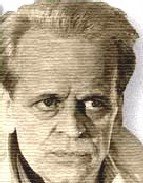
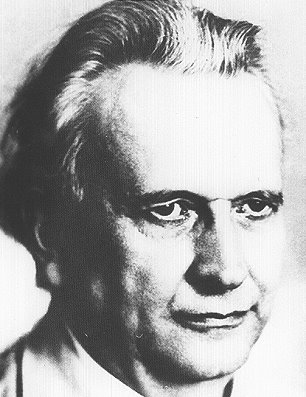
Lookalike: Klaus Kinski and Karl Jaspers

Two great men: one a "sex-crazed maniac", the other a well-loved actor.

Thursday, January 19, 2006

Joseph Beuys in America


"With methods meant to seize the ready-made, it [science] cannot in general enter into what is being done, it cannot follow the moving reality, adopt the becoming which is the life of things. This last task belongs to philosophy. While the scientist [...] is obliged to use craft with nature, to adopt toward it the wary attitude of an adversary, the philosopher treats nature as a comrade. The rule of science is one posited by Bacon: obey in order to command. The philosopher neither obeys nor commands; he seeks to be at one with nature." Henri Bergson, Creative Mind p126.

Tuesday, January 17, 2006

The Book of Pleasures

Last night, over the course of four hours continuous reading, I discovered Raoul Vaneigem:

"Sabotage, absenteeism, voluntary unemployment, riots, wildcat strikes, stealing for fun and doing things for the hell of it - the axe is laid to the commercial tree and I'm delighted. As sure as work kills pleasure, pleasure kills work. If you are not resigned to dying of disgust, then you will be happy enough to rid your life of the odious need to work, to give orders (and obey them), to lose and to win, to keep up appearances, and to judge and be judged.”
The Book of Pleasures, p20.

"To drink, insatiably thirsty, at the 'cup of life' is the best guarantee of its never running dry. Children know it - they take everything as if it were an unlooked-for present. Lively senses make their world live, long before the economic imperative starts totting the bills run up by life; before they learn about reciprocity; before they set out to deserve their presents, demand their due, be rewarded for winning, or punished for a depreciation, or thank those who remove one by one the charms of an existence without opposition." Ibid. p38.

"Women have long shared with artists, children and madmen the privilege of shrieking, singing, weeping, throwing their arms about, offering any old thing in gift, and betraying what is usually kept quiet. Since industrialisation won them the priceless right to work in a factory, gain a wage, run a business and command an airborne division - while artists became civil servants and promoted culture - only children and the so-called mentally ill are left to give confused expression to the convolutions of language prised from the grip of trade." Ibid. p48.

"If someone strikes me on my left cheek, I will smack him in the teeth sooner than offer him my right. Is not my enemy whoever constrains me, threatens me or makes me feel guilty? I want to live what I specifically am, without norms and without always watching for someone waiting for me at the corner of the street. If I kill what represses me, it will be inadvertantly, as I stride out happily, without looking back." Ibid. p65

"Nothing is passionately interesting if you are counting the pennies or feel forced to do it. Only desire teaches us to live. You hear people all to often weigh their words and pause for you to admire profundity. Desire, on the other hand, leaves everyone to work out his own way in silence." Ibid. p92.

Monday, January 16, 2006

More mischievous troublemaking


"Foucault said once that with Deleuze philosophy became theatre. Well, with the English Deleuzeans it becomes circus. Philosophy for clowns."
So M.arc opens the comments to my previous post. Golly, dogmat has never seen so much activity!
Clowns, eh? Those sad, determined faces. There is no lightness, no real joy to be found in the circus - a heavy, frightening place filled with jeering laughter.

"...hope it is not going to go Nick Landish again…" whistles the anonymous Jean X, (the cadence of the passage suggests a certain regular commentator). Nope, I don't think it will. Nick Land and his 'movement' seem, with bleary hindsight, to have been able to laugh at themselves. With the new "Deleuzean mafias" (such a snappy catch-all phrase: thanks, Marc), I'm not sure fun poking is permitted.

Often I find myself fielding questions about whether I shall be taking part in this or that reading group or seminar. I tell my friends, "I am not interested in becoming a Deleuzian along with everyone else. I want to engage with him seriously when I am ready; and I am not ready." Their eyes cloud over with suspicion and concern. Someone brandishes a text at me, another lays a threatening/forgiving hand on my shoulder. Do I want my academic career to sleep with the fishes?

Friday, January 13, 2006

Rebels D&G: now the fashionable orthodoxy?

I'm talking about Deleuze and Guattari™

I was sitting peacefully in Raffles yesterday, reading Wittgenstein's Nephew (Thomas Bernhard), when two people sat down next to me. Mr O started to talk. His voice could only be described as the voice of someone who knows.
"Thousand Plateaus is a work of...[inaudible]...,"
He then tried to address his interlocutor's concern about the contents page:
"...transversality of concepts, you see..."
The hapless student tried to drag the discussion on to familiar territory - a novel he'd lately read involving 'virtual-something'. Big mistake, friend.
Mr O swept aside this impoverishment with a short speech about the difference between the possible and the virtual (I hope this is right - I am writing from memory, and my shameful ignorance isn't helping.)
The momentum built up during three minutes of continuous talking made him almost unstoppable:
"...Deleuze and Guattari™ are only interested in the aesthetics of composition..."
He didn't say "...my dear boy," but he could have.

Mr O has adopted the attitude of the expert. He has reached that point in his intellectual development where he is permitted to drop the hesitancy, and the tentative sounding remarks. He stops thinking for himself, but now has a duty to think for others. His role is pedagogical.
I took an immediate dislike to him.

Tuesday, January 10, 2006

The malady of the yes-sayer

A friend is ill. I am back in damp dark dank midlands. I don't feel like posting anything. "Looking away shall be my only negation."

Monday, January 09, 2006

Saturday, January 07, 2006

Thursday, January 05, 2006

Is this a meme?

1. What did you do in 2005 that you'd never done before?
I began to write (essays, blog, etc) more regularly.

2. Did you keep your new years' resolutions, and will you make more for next year?
My new new year's resolution is below. I should also say that I don't want to put anything more on this blog about academic philosophy politics in 2006. I am not a gossip columnist.
I didn't have any resolutions last year.

3. Did anyone close to you give birth? No.

4. Did anyone close to you die? No.

5. What countries did you visit? Sweden and South Africa.

6. What would you like to have in 2006 that you lacked in 2005? Excitement about returning to London to earn a living.

7. What date from 2005 will remain etched upon your memory, and why? None in particular.

8. What was your biggest achievement of the year? There wasn't any single achievement. I did one or two things which I am reasonably pleased about.

9. What was your biggest failure? Not working as hard at philosophy as I know I should've.

10. Did you suffer illness or injury? No.

11. What was the best thing you bought?
A book - probably Kant's Critique of Pure Reason. It was whilst reading this that I felt for the first time that I was being serious about thinking.

12. Whose behavior merited celebration? My brother's. He returned to school this year.

13. Whose behavior made you appalled and depressed? Ha! There are so many names.

14. Where did most of your money go? Coffee and fish-fingers.

15. What did you get really, really, really excited about? Kant, Merleau-Ponty, Nietzsche, and (obviously, I hope) in a different way, New Orleans.

16. What song will always remind you of 2005? Bob Dylan's Maggie's Farm, just cos my Dad and my little sister got hooked on it over the holidays.

17. Compared to this time last year, I am... less interested in taking my own life.

18. What do you wish you'd done more of? I wish I'd tried a little harder to connect with people, especially strangers.

19. What do you wish you'd done less of? I could have done with less fatuous grumbling.

20. How will you be spending Christmas? With family in a town in the middle of South Africa, eating lebanese food.

21. Did you fall in love in 2005? I couldn't say.

22. How many one-night stands? Hmm, let's just say that my mind (and my body) doesn't function in a way that is conducive to drunken sex with strangers.

23. What was your favorite TV program? I was introduced to Arrested Development by my housemate Axel.

24. Do you hate anyone now that you didn't hate this time last year? Not really. Hatred, for me, is a fleeting emotion.

25. What was the best book you read? Tough. Two books which really opened up my thinking were Henri Lefebvre's Rhythmanalysis and Nietzsche's Gay Science. Another marvel was Thomas Bernhard's Concrete, which M recommended me.

26. What was your greatest musical discovery? There were quite a few. Jimi Hendrix and Bob Dylan, so far as pop music goes. Charlie Chaplin's compositions, which provide the soundtracks to his films, were a treat (the music for The Circus - what beauty!). Plus 'live' classical music; something which I have never really enjoyed before.

27. What did you want and get? An education.

28. What did you want and not get? An education.

29. What was your favorite film of this year? I've not seen many new releases. The best film I saw for the first time was possibly Renoir's La Regle du Jeu.

30. What did you do on your birthday, and how old were you?
I spent the time with my mother in London, I think.

32.What one thing would have made your year immeasurably more satisfying? More reading.

33. How would you describe your personal fashion concept in 2005? Second-hand (including shoes, excluding underthings). Style never goes out of fashion and all that...

34. What kept you sane? Talking to close friends.

35. Which celebrity/public figure did you fancy the most? I found Judith Butler more than a little attractive. And then there was Alcibiades, in Plato's Symposium.

36. What political issue stirred you the most? I surprised to find that my warped weltanschauung was given credence by the events in New Orleans and Iraq.

37. Who did you miss? Various family members. My colleagues from the last job I had before taking up philosophy study full-time.

38. Who was the best new person you met? Brn.

39. Tell us a valuable life lesson you learned in 2005. Fuck that for a game of eggy soldiers.

With gracious thanks to Fort Kant.
Saturday, December 31, 2005

For the new year

"I still live, I still think: I still have to live, for I still have to think. Sum ergo cogito: cogito, ergo sum. Today everybody permits himself the expression of his wish and his dearest thought; hence I, too, shall say what it is that I wish from myself today, and what was the first thought to run across my heart this year - what thought shall be for me the reason, warranty, and sweetness of my life henceforth. I want to learn more and more to see as beautiful what is necessary in things; then I shall be one of those who make things beautiful. Amor fati: let that be my love henceforth! I do not want to wage war against what is ugly. I do not want to accuse; I do not even want to accuse those who accuse. Looking away shall be my only negation. And all in all and on the whole: some day I wish to be only a Yes-sayer." - Friedrich Nietzsche, The Gay Science.

Thursday, December 29, 2005


'Yass yes yes...' he said, rubbing his belly.

Tuesday, December 27, 2005

'Segregation? Not since 1994...'

My father and I gave a lift to two men who work at the house where we were staying. We took them to their home, a township 30 miles outside Bloemfontein called Botshabelo.
Sam and Willem, father and son, tend the vegetables in addition to working for a furniture restoration business. They are employed by my step-mother's father, an imposing man who on first impression bears out Nietzsche's claim that "anyone with a very loud voice is almost incapable of thinking subtleties." He is, on the contrary, however, a complex and interesting man who overflows with generosity, hypnotic power, and booming laughter.

On arrival at Sam's house, he introduced us to his wife, and showed us around. It was hot, since there was no ceiling - only an asbestos roof; but the house did have electricity and running water, which is something of an advancement.
Botshabelo, we discovered, is a town of its own, with a shopping centre and different districts. Two things distinguish it from any 'normal' town - there are not street and area names, but codes made up of numbers and letters (Sam's home is in K section). Secondly, in the hour and a half that we spent there, I saw only one white person, a farmer driving in his car.
The apartheid planners left quite a legacy. Botshabelo, which began as a settlement for those forcibly removed from more rural areas, is too far from Bloemfontein to attract anyone else to live there. In the 'new' South Africa, it is (slightly) more possible for black men and women to lift themselves out of township poverty, but there seems to be little likelihood that a town such as Botshabelo ever develops into a vibrant and diverse place to live. This is very unfortunate, since it has a certain good character. As is the way in this wretched country however, my father and I were warned not to get out of the car, lest the 'dark hordes' have their way with us. Foolish nonsense! (which, I am coming to realize, is not so harmless as all that.)
After unloading Sam's bags, we headed over to meet his brother, who runs a small liquor store from his house. He invited us into his living room for a beer (in fact, we initially invited ourselves, because of a mix up which involved my father mistakenly thinking we were in an illegal drinking establishment). Nonetheless, we all sat down and talked, about local football (Kaizer Chiefs is the name of a club as well as a band) and morogo, a food made from potato and spinach.

Wednesday, December 21, 2005

Bloemfontein

My South African odyssey has taken me to Bloemfontein, a large town in Free State province. It is a relaxing place for me, because I do not know it well, and it does not know me well. I am freed from the wealthy middle-class rut of my home town.
Yesterday afternoon, I took a long walk on the wide, dry boulevards. I had been given directions, but I decided this time to get the 'conditions of possibility' to work for me. It is a condition of possibility of a planned walk that the route be deviated from (if this were not the case, it would mean that I could walk in any direction and still get home). Deviate I did, into some rather rundown districts; you know you are getting to the interesting parts of a town when sex-shops begin to appear. I saw very poor white men, an unusual experience even now. They have very tanned skin, which contrasts with their sun-bleached blonde hair. There is a broken look in their eyes.

Stumbling along the hard shoulder, I found a chess piece in the gutter - a rook, or castle. The castle symbolizes Bloemfontein well. The white, afrikaans speaking community here is a bastion of the old values of apartheid. This is a place where men are men, women are not much at all, and body-building supplements have a prominent place in every supermarket. On the other hand, black Sotho-speakers make up 90% of the population here, and since the fall of the old regime, they have come to occupy almost all the important regional government posts. A castle, we may note, doesn't change hands by degree - it is held either totally, or not at all.

Ants

I see two ants crawling - walking - towards one another. They meet and pause for a few moments, perhaps slightly longer than usual. How do I interpret, or understand, this?
Were I to see two humans meet, I would speculate about whether they know each other, are old friends, etc, depending on how long they remain together (if they are too distant to for me to see gestures and hear voices). With the ants, I cannot posit any self-awareness. Even if the ant has some sort of information, or message, to convey, I must think of this in purely functionalist terms. The ant has not been given a task - rather, this is simply something that ants do. And this in turn must be conceived instinctually. Can we make an analogy with breathing, or the beating of the heart? Or would this conception force us to consider an ant colony as a single organism (and if so, what is the problem with this)?

Monday, December 12, 2005

Report from South Africa III: the long goodbye

Leaving my house in Coventry at 3am presented two main dangers: rain, and drunken revellers. Rain threatened, and drunken revellers impressed me with their cogency.

"What are you doing with a suitcase at this time of night?" asked a girl, who felt that I was more interesting than the argument that she was having with her boyfriend. Before I could respond, she squealed "you're getting married, aren't you?!"
Smiling no, I withdrew.

Report from South Africa II: the good old days

To atone for my previous post - an ill tempered diatribe - I present a selection of 'humourous' excerpts from apartheid discourse.

We do not believe that the Native is really a communist at heart. He is not able to form a conception of the ideology and of the dialectical materialism of their doctrine. - Dr N Diederichs, House of Assembly, 1948.
A large proportion of your Natives today are still savages, others are semi-civilized, others are more or less civilized. - Minister of Justice, 1959.
In the past the torch of civilization had been kept burning in the country because "among other things our forefathers were such good shots." - Minister of Defence, 1961.

Mata Buela, 36, was fined R30 (or two months) this week, for stealing a banana. The value of the banana was placed at one cent. It was his first conviction. - Newspaper report, 1961.

At least ten people have now died in Mamelodi since yesterday morning, according to unconfirmed reports. The figure is expected to rise after police have completed their investigations. - Newpaper report, 1985.

A 13-year-old African babysitter appeared in court on a charge of assault because he hugged a white child in his charge. He had knelt down and opened his arms, and the little girl had run to him and they had hugged. - Newspaper report, 1985.

I don't think I need add anything to this, except perhaps the words "scott free?"

Friday, December 09, 2005

Report from South Africa I: Hegel

I am on holiday in Cape Town. I should like to say one or two things about what we might call the 'situation' here. That is not to say, the political situation. Rather, the situation in general.

I am already fed up with the tiresome fawning of people working in the service industry. Buying a coffee, for example, feels more like an encounter with some deluded supplicant: the customer is a deity, whose every wish is granted. The waiter/shop assistant clings to the customer like a cheap suit.

This creates a rather problematic relationship, which Hegel understood particularly well. People here - South Africa - expect to be treated like royalty when in a shop or restaurant. Staff duly oblige ('you are dispensable - there are ten people who would happily take your place here'). But we cannot help but ask: what kind of esteem is this?
'I am a king - see how they treat me!'
The 'they' is elusive, like Hegel's subhuman slave.
Who could truly value the worship of these coerced, subservient wretches? Only a bunch of deluded fools. The kind of deluded fools who could convince themselves that apartheid is right and good, perhaps? Well, we needn't go that far. Yet.

The spirit of apartheid is still very much alive. I must emphasize, however, that I am not only talking about black service staff. The same lamentable self-abasement is demonstrated by white student jobbers, and shopkeepers.
The petty desire for wielding power over others, which was a condition of possibility for apartheid, is now satisfied by our 'legitimate' capitalist regime.
'I don't care whether he is black or white - I want him to lick my boots because I have paid for the privilege!'

Monday, December 05, 2005

Rousing rhetoric or messianic twaddle?

'Gentlemen' he said,
I don't need your organisation,
I've shined your shoes,
I've moved your mountains and marked your cards,
But Eden is burning,
Either get ready for elimination,
Or else your hearts must have the courage for the changing of the guards.
nnnnnnnnnnnnn nnnn- Bob Dylan, Changing of the Guards

Dogmat circulates

O end of term dilemmas! Which party to go to? In the final analysis, I chose the path of least resistance: Matches' birthday bash. I gave him a rather fetching old copy of short stories by Bertrand Russell, a suitable gift for the continentally challenged.

After a thoroughly useless Saturday, I thought that a quiet spot of red tea would do the world of good. And it did. I had a few interesting talks with people. My opening gambit of the evening was "if you had to choose between a person getting killed, or the Mona Lisa being destroyed, which would you go for?" This was a discussion that I had been having during the day, with Lila, Axel, and, later, Brn. Does it sound like a piece of philosophical impoverishment? Yes, well, ole Danny Dennett talks about it somewhere in one of his popular science works (the book just happened to fall open on this - obviously well thumbed - page while Axel was perusing it), and it certainly has all the hallmarks of an irritating Anglo-Saxon thought experiment. And yet...

I also had the good luck to chat to a Norwegian physics student, who gracefully explained what Wave-Particle Duality means, why the sky is blue, what a quantum computer can do (and why), and how a hologram works. What's more, he enjoyed it, unlike the last physics student I happened upon at a party, whom I coerced into explaining the theory of relativity, with diagrams, equations - the works.

As nights draw in, academic gossip intensifies. Glueboot emailed me the other day, to tell me that our new VC (who'll be replacing Marty Vanderpoot) has written on Deleuze and Virilio. Maybe we can wonder how much he can have learnt from these thinkers considering that he is now an administrative bigwig, but maybe that isn't necessary - it is good news all the same.
I also heard a piece of broken telephone speculation which seems so unbelievable that it would be irresponsible to reproduce it here...
A Baudrillardian friend told me that he was told that Professor Elusive-Hyphen wrote an email to every member of our philosophy department saying simply: "If you want all the Continental philosophers to leave, just say so."
Even if this tale isn't true, or has been distorted beyond recognition, I want to believe it. I find it comforting to know that at least one of my teachers has some cojones. Dammit!

Later, I had been trying to describe the difference between Sartre and Merleau-Ponty to a Wittgensteinian pal, when we were interrupted by someone drunkenly frolicking.
When we resumed our discussion, he said: "What were we talking about again? Oh yeah, Wittgenstein..."
No, we were actually talking about phenomenology you fuckwit.

Hup hup. Forty-two! Sixty-seven! Go long!

American Football is such a strange sport. Like the way that the game is broken up endlessly, and the time between plays filled with studio analysts' inane drivel. They waffle about taxicab problems, or how much money they have bet on the game. When they think that play is about to begin, they cross over to the US commentators, who are picked up mid-sentence, so all the viewer hears is gruff laughter followed by "that's right John..., now back to the action."
And they say cricket is odd.

Friday, December 02, 2005

Google Maps

What an innovation - here is an image of the neighbourhood where I grew up (my house is in the centre). And note that it is possible to zoom-in still further, for extreme detail.

Thursday, December 01, 2005

You know you are bored when...


...you try to temper tinfoil on the stove, whilst waiting for the coffee pot to boil.

Arbeit Macht Frei

More unusual days. I was with S is some sort of postgraduate room near the philosophy department. What began as a little look at the Goebbels Diaries (which happened to be on the shelf), ended up as an investigation into Prussian Blue, a rather fascinating white-supremacist pop duo. Following up links, we stumbled around in neo-Nazi blogs, which are quite nasty but very difficult to take seriously. There was the charming young blogger named simply fraulein, who listed as her dislikes "gays and mix people" (sic). An honest, but shamefaced lad described his hair colour as "umm, brown". He won't be given an easy ride, that's for sure.
At least some bloggers were still trying to keep something of an open mind. One chap listed as his favourite books Mein Kampf and 100 Years of Solitude. Now I reckon only one of those is on the KKK bestseller list.

After that madness I went to a rather good concert with M and Lila. This was an unfortunate turn of events for my housemate, Axel, who had mistakenly locked himself in the lounge at home. When Lila and I returned to the house later that night, we found him stoically settled on the couch, watching DVDs. Poor poor boy.

Tuesday, November 29, 2005

Kids: don't do ddrugs

It was halfway through scoffing a caffeine tablet last night that I had the shocking revelation that it wasn't of the 'chewable' variety. Not a pleasant experience. I don't know why I bother - they are such pathetic little things, barely extending my concentration span by more than twenty minutes. How I long for the days when stimulants were stimulants and philosophers went blind at fifty. Take that old favourite, Corydrane (discontinued). It doesn't just keep you awake, it gives you to think. Sadly, in Sartre's case, it also gave ill health which ultimately led to his death (always read the label).

A ceasefire for Christmas? Like hell...

Things are bad in Britain today. This is dawning on me. We could blame it on the slavish middle Englanders with their Daily Mail and their ressentiment; we could blame it on the the complete dominance of capitalism - a dominance which has no outside, which rules out any conception of true opposition. Everything has become "recuperable", in the language of the marxists. Culture, literature, film: all reduced to commodities. Of course this has been said many times before. But the horror of it can only be appreciated when it is experienced, when one is struck by the realisation that all those dark claims about this and that sorry state of affairs, were not simplifications or mistaken misanthropy. We can shrug when sitting on the bus, listening to M shouting about how London winning the Olympics and the philosophy of mind coup d'etat in our department are "the same thing." Except that I am realising, for all the silliness of it, that maybe he was right.

I had the radio on in the background the other evening, when a programme began. It was called Composer's Notes. "Ah", I thought, "maybe I can learn a thing or two about music." Can you imagine my dismay at discovering, within a few seconds, that the show was all about how much money a composer was paid for his work.
"Rimsky-Korsakov: rich or poor? Let's find out!" To this, I can say only one thing - Firing squad.

In other news. The latest departmental shenanigans have developed out of two issues: i) the gradual metamorphosis of the 'history of philosophy' into the 'history of British philosophy'. Less Spinoza and Leibniz, more Hobbes, Mill, Bentham etc, and Kant being made optional for joint honours students and pushed into the final year (if my memory serves me correctly - I do have more important things to think about, you know). What follows from this is that Post-Kantian philosophy gets completely marginalised, and will eventually fall away completely.
And ii) a ridiculous selection panel for the new 'aesthetics' post in the department. Dave Distiller knows his mind, but I doubt he knows anything about the philosophy of art. 'Analytic aesthetics' is a contradictio in adjecto if ever there was one.

While those cunning guttersnipes are raping and pillaging their way through the prospects for continental philosophy next year, this year's students have arranged an interdisciplinary football match. Think of the game played between Tommy and the Fritz on Christmas day during WWI. Except that this is more like WWII, in terms of enmity and war crimes.

Friday, November 25, 2005

My occasional forays into k-punk's blog have been rewarded with today's rather interesting post on Zizek send-ups, and how to get "down and dirty" with alternative economics.

Wednesday, November 23, 2005

Xavière

Sitting with my coffee, I began to listen to a conversation two students were having at the table next to mine (eavesdropping, I know, but unavoidable). I'd seen them come in; one had blonde hair, a slightly foreign accent and a russian-looking face (if there is such a thing). The other unmemorable: I don't remember. I could hear the accented voice talking about a man she was attracted to, but who was involved with someone else. "I don't want to break them up" she said. The friend mumbled platitudes.
"I'll make friends with him - surely there is nothing wrong with being friends." The unmemorable one didn't answer: it wasn't a rhetorical question to elicit advice, just a bold statement of fact.
I began to think of Xavière, Beauvoir's ill-fated character in She Came to Stay. I didn't like Xavière. She infuriated me.
My neighbour reminded me of Xavière: the terrible mixture of naivité and diabolical intent; the sense of impending disaster. She forces everyone who encounters her to realise that this world isn't a Schopenhauerian world.
One moment in her company will be infused with indescribable shades of exhilaration, followed by another of almost farcical exasperation.
'Suffering and boredom', my pessimistic German friend?

Saturday, November 19, 2005

'The sexual act is in time what the tiger is in space'

Brn and I were standing outside the library in the freezing cold. I was trying to explain to him Derek Parfit's view of personal identity (which Parfit elaborated with some wild thought experiments). Our talk progressed as follows: I would say something about branching chains of psychological continuity, and he would ask me about rhizomes. I would attempt to explicate the difficulty I was having with memory on Parfit's schema, and he would reply with the bergsonist complaint that Parfit (and just about all other analytic philosophers) cannot really think time.
Fascinating stuff. Less fascinating for the fact that I was about to make a presentation on the topic.
Looming deadlines notwithstanding, our confabulation moved on to more fertile ground. Derrida and Bataille, and the notion of 'gift'. There were times reading the Accursed Share when I felt that Bataille wasn't being radical enough in his analysis. His interpretation of the function of potlatch in various societies remained (I thought) closely bound to capitalist conceptions of exchange value. Gifts are given in return for esteem. Brn held that this is very different from how things are today: that it was precisely the act of giving which symbolized power and wealth in times past. Perhaps this is close to what Deleuze means when he says that the will to power consists not in taking, but in creating and giving.

In any case, Brn went on to say that he thought my issue was similar to something Derrida wrote on the topic; that we cannot explain the gift except in terms of an economy. Now my knowledge of Derrida's work is negligible, so forgive me if I have misunderstood.
This problem of the gift reminds me of the puzzle of motivation, which is usually encountered when thinking about egoism. Every act is motivated, so surely, they say, all action is in some sense egoistical. No, I always think: but why not? Likewise for the gift - it is impossible for me to conceive of a gift which is not reciprocated. There must be exchange, or the hope of exchange, for, as a purely giving being, I cannot survive.
What I wanted from Bataille was an account of the gift which is never reciprocated, and whose reciprocation is not even hoped for. Only then will the structure of capitalist transaction be called into question. Of course, the difficult part is removing oneself from any and all systems of economy: on the plane of motivation, this is what Kant, amongst others, tried - and failed - to do with his categorical imperative.
In the short time we spent standing in the cold, we could only think of two ways to accomodate pure giving: to accept death as the outcome, or to embrace irrationality and madness.

Merleau-Ponty and the 'racaille'

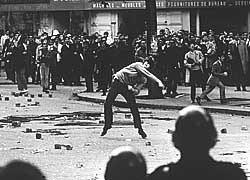
Writing sixty-years ago, Maurice Merleau-Ponty foretells the explanatory mechanisms used to anaesthetize the behaviour of urban french youths, turning potentially revolutionary activity into mere vandalism.
We do not want to say, along with most of the mainstream media, that "we have here blind, 'elementary forces' cleverly exploited by a few shrewd agitators. It is possibly in this light that the prefect of police will view history." -Merleau-Ponty, Phenomenology of Perception (my italics)

Friday, November 18, 2005

That friday feeling

I had a post-kantian philosophy seminar a little earlier, in which I only uttered two words: "pineal gland" (an artist's impression, right).

Wednesday, November 16, 2005

Idle waffle

What fun. After a few weeks of teaching, my lecturers feel that they can relax in the company of their students. Good news for bottom-feeding pseudo-intellectual gossip blogs like mine.
Doctor Ampere shocked students with a diatribe on the evils of marketing. Advertising can never be art: those who direct their creative efforts towards increasing the sales of goods and services are "removed from the artistic register forever."
He also dismissed those shock-artists who, in effect, do nothing more than "piss around in the media". He then articulated a more subtle position, distinguishing between truly radical art and shite (elephant shite?).

Professor Elusive-Hyphen, on the other hand, showed his contempt for student opinion in a more hostile and daring way. During a lecture on Nietzsche, a Rag Week mob knocked on the door to the hall. "Five minutes for charity?" they ejaculated.
Elusive-Hyphen thought for a moment, then said distinctly: "No. No, not at all." When they were gone, he marvelled at their insolence: "Five minutes for charity...I was in the middle of a line of thought...no way...fuck off. Five minutes...charity...yes, fuck off."
This was met with stunned silence, followed by the nervous pawing of Make Poverty History wristbands.

By the by, I bumped into Dave Distiller in the loo yesterday, and I realised that you never really know a professor until you have heard him say "a phenomenological account of transcendental arguments" with his penis in his hand.

Monday, November 14, 2005

Not sleeping, but thinking

I was getting a glass of water at a campus cafeteria when I overheard a customer say to an absent-looking friend of his working behind the counter: "Are you sleeping?"
The friend replied: "No, I'm thinking."

We live in busy times: if you don't look frenzied and stressed, then people think you're some kind of drop-out. All those dynamic students at the business school: they've already bought next-year's Travelcard, in anticipation of a bright future in the City.

As for my future: well I can't bear the thought of returning to the Buerkbeck lifestyle, of a mindless day's work followed by a nap in some lecture theatre or other (whilst a Grayling prattles on about epistemic castration), and I haven't much chance of securing funding for further study. I would like to say that this is because 'strictly academic' writing doesn't agree with me, or because I do not ingratiate myself with the faculty members; but this would give the impression that I am following Beckett's dictum, to "try again, fail again, fail better." On the contrary, mediocrity seems to cling to me - I can't convince myself to be any better than 'fairly good', to emerge from my torpor. Yes, I work fairly hard, I am fairly erudite. I have a moderate appetite for knowledge. But this isn't at all satisfactory.

Of course, I am not in a position to make the same sort of witty remarks as Spurious; and I wouldn't want to claim that the 'success stories' of academia are talentless automatons churning out paper after paper and book after endless book. But I do feel that philosophy has come to be viewed as a career choice like any other, to be pursued like a career in finance or law. Ruthlessness is required, along with a talent for 'ticking all the right boxes'
Is this thinking? Is this the only way to open up possibilities for thinking?
Perhaps a careers advisor can help me...

Paul Auster

The article in this weekend's paper reminded me of my former love for Auster's work. I don't dislike his writing, it's just that I feel I have moved on. Mind you, I did read Siri Hustvedt's first novel lately, and I very much enjoyed it (maybe a little popular for some tastes).

I once had a wonderful dream about the two of them (they are married). They had thrown a party at their house, and I was on the balcony talking to Hustvedt. Since this was before I'd read any of her books, I actually wanted to speak to Auster. It was a tricky situation: I remember feeling so honoured to be speaking to a well-known writer, yet feeling anguished and desperate about making it across the crowded room to speak to my hero.
And so the surrealists are refuted: even etiquette has a place in the illogical world of dreams.

Sunday, November 13, 2005

Flies


Sitting in the library yesterday, wrestling with the Kantian sublime, something rather odd occurred. The flies in the library are drawn to the fluorescent lighting, throwing themselves against the hot bulbs. This makes them incredible drowsy. One fell from the ceiling, tumbled off my head and landed on the desk. I put my hand next to him (it? her?) and he crawled over my finger. I shook my hand but he stayed rooted to the spot. What a strange sight: a black fly walking over my hand in a docile and pet-like fashion. After some seconds, he gathered the strength to fly away.

ps. Vincent Price is a dude.

Thursday, November 10, 2005

Coincidence: the post that never was

Last week, on my way back from London on the coach, I saw a lorry hauling a tube carriage. A little later I saw another lorry pulling an aircraft fuselage. Whilst in London, I crossed paths with the same people twice. And this happened more than once. Let's just say that Soho's very own Abyssinian goth haunt, the Intrepid Fez, was involved - I'll say no more.

In any case, I was going to fashion this into some sort of highfalutin' commentary on coincidence, drawing on the work of Paul Auster, and Andre Breton's Nadja. But then I thought: why bother? (Plus, this way I give the impression of being interesting, without having to commit myself to anything at all.)

Tuesday, November 08, 2005

Lovecraft's philosopher-siren

"She was, I judge, about twenty-three at the time; and was taking a special course in mediaeval metaphysics [...] She was dark, smallish, and very good-looking except for overprotuberant eyes; but something in her expression alienated extremely sensitive people. It was, however, largely her origin and conversation which caused average folk to avoid her. [...] All animals markedly disliked her, and she could make any dog howl by certain motions of her right hand. There were times when she displayed snatches of knowledge and language very singular - and very shocking - for a young girl; when she would frighten her schoolmates with leers and winks of an inexplicable kind, and would seem to extract an obscene and zestful irony from her present situation."
-H.P. Lovecraft, The Thing on the Doorstep and Other Weird Stories.

The spiders are back

This time around they are smaller and more prone to climbing the walls than scuttling across the carpets.
I knew something was wrong when I woke up one day covered in sores. Then the other evening I captured one on the wall above my pillow. But there was worse to come - last night a tickling sensation on my neck turned out to be a small arachnid. I'd suspected some sort of creature, so I began to flick at the feeling. Lo and behold: the little feller was catapulted onto my desk, while I busied myself suppressing a yelp.

Sunday, November 06, 2005

Another day, another dogmat?

The Nietzsche reading group is going from, er, strength to strength - Brn and I spent much of Saturday looking at Deleuze's little, as yet untranslated, introduction to the man. What an experience: working through the French text made me feel like a real philosopher (ok, a real scholar, but nonetheless...)
Whilst discussing Baudrillard - "are you having fun yet?" - we discovered that the worldwide success of reality show Big Brother does tell us one thing: Kant was right about the sensus communis.

The capital city of this great land

Last week, I went down to London for the day. How refreshing to be away from here!
I bought a few books and walked all over the place (strolling along the South bank of the Thames on a weekday morning is utterly marvellous).

I had dinner with my mom and my uncle in the Stockpot on Old 'Straight Outta' Compton street (anyone who lives in the capital but hasn't eaten there needs to put this right). A little earlier, I'd found myself standing in Piccadilly Circus talking over the crowd to my mother about the plot of Mulholland Drive. Unfortunately I could only remember how the story supposedly unfolds, but I don't remember why.
That rascal Socrates was right when he said in the Meno that true opinions "run away from a man's mind, so they are not worth much until you tether them by working out the reason."

Monday, October 31, 2005

Raffles madness

Oh the irony. All those post-colonial literature folk forced to drink their tea and coffee in a cafeteria named after the great imperialist Sir Stamford Raffles.

I was sitting there reading Nietzsche when I had a strange encounter with M and a new postgraduate student. I was telling M how much I was enjoying The Gay Science when this dude - an Irigarayan - started asking if we were 'gay scientists'. Over and over again.
M asked him if he was one and he replied while walking away: "I don't take a whip when I go to meet women." We furrowed our brows, and M duly noted that we were talking about Nietzsche, not Sade.

That was quite enough madness for one day.

Day of rest

What an odd weekend I have had. My housemates and I were feeling in something of a bataillean mood, so we decided to freeze an egg, hoping to chip the shell off and reveal a frosty egg-shaped marvel. It didn't quite work out as planned, since the 'white' didn't remain clear as we expected, but became opaque.
M asked whether, in truly excessive fashion, we urinated on the egg or pulled someone's eye out. No I replied, we didn't. We did pass the slimy defrosting object to each other, but this activity was of a non-sexual nature.

Later I forced my housemates to watch Derrida Does Dallas. Afterwards, we thought for a short while about the question posed to 'Jacqui': which philosopher would you like to have been your mother?
Except we decided to interpret the question in what might be called a more literal sense (watch the film and you will understand what I mean).
I settled on David Hume. A great thinker with a reasonably pragmatic general outlook. I don't know much about his life, but I do know, from his texts, that was a relaxed sort of chap, and that he believed there is a time and a place for sceptical doubts. For example, I think he would agree to set them aside whilst engaging in certain sorts of parental activities with me.
It would have been a whole lot easier to suggest a 20th Century philosopher for the role, such as Foucault, or a woman, such as Beauvoir, but we thought this would be cheating (let's not consider the political implications of privileging women thinkers for the role).
As for my housemates - Axel muttered a few things, but I don't remember exactly who he decided on, and Lila shouted 'Freud!' from the top of the stairs in an obscure act of defiance.

Friday, October 28, 2005

Wednesday, October 26, 2005

The obscure delights of Coventry

They never cease to amaze me. When I arrived here, I assumed that the most loathsome part of my journey to and from campus each day would be verbal, physical and psychic assaults from 'the locals'. How wrong I was: the supposedly yobbish youngsters loitering in the street provide such pleasure that I now look forward to being accosted.
Last night, for example, when walking past a group of robust-looking teenage girls, one of them broke into a Ministry of Silly Walks silly walk. What an unexpected joy. And there was nary a cuss to be heard, nor a dilated pupil to be seen.

And this was not the first time. A few months ago, a boy sidled up to me on his BMX while I was cycling home. In his best cheeky chappie voice he said: "Nice bike - wanna swop?" Now I must insist that my - racing - bike is utterly unsuited to any sort of BMX scallywaggery; he spoke in a sincere but silly tone, as though he thought that I might turn down his offer(!) Yet his remark can only be made sense of as deeply, deeply ironic: what on earth would he do with a bicycle like mine?

Last year, while walking home, I passed a family (an obese mother surrounded by raucous children of various ages) moving ('walking' is not the right word to describe this amorphous chaotic mass) in the same direction as me. As I overtook them, one of the kids asked of me: "Dude, are you the Matrix?"
Oh how I laughed - where do they come up with this stuff? And why do they make the students at my university seem so boring?

Tuesday, October 25, 2005

"If it be knowledge or wisdom one is seeking, then one had better go direct to the source. And the source is not the scholar or philosopher, not the master, saint, or teacher, but life itself - direct experience of life. The same is true for art."
Henry Miller, The Books in My Life.

Friday, October 21, 2005

Philosophical labours

I am feeling the aftershocks of my first work-through-the-night of this year. Sitting at my desk, at four this morning, puzzling over the nature of aesthetic judgements, I remembered how right Adorno was when he described proper thinking as "the strenuous toil of conceptual reflection." (Quoting Hegel's Phenomenology)

BONUS: Pictorial representation of the calamitous mental misadventures of 'conceptual reflection,' courtesy of Arthur Schopenhauer.

Wednesday, October 19, 2005

The petty politics of academia: What Would Nietzsche Do?

Today, I had a rather strange lecture with Professor Elusive-Hyphen. He was talking about Schopenhauer's ethics, and how the ethical life involves a denial of the will-to-life: instead we tend towards a kind of death, as the culmination of pure asceticism. He added in a quiet voice, and much to my surprise, that he didn't mean "living-death, in the way that we might say some members of the department are dead."
In fact, this startled me so much that I am tempted to doubt whether he said it at all. But he did say it. Ah, such enmity - it brings tears to my eyes.

We owe it to ourselves to speculate libellously about what exactly this cryptic statement could mean. Is he alluding to the vacant looks that he gets when attempting to talk to his colleagues about anything other than neuroscience? Or perhaps he means the zombie-like fashion in which creativity is relentlessly stifled in our accursed fackulty?

"Forgive them father, for they know not what they do..."

Tuesday, October 18, 2005

Friday, October 14, 2005

Nietzsche and dogmat: together at last

Tomorrow morning, I shall begin my long-awaited engagement with the work of Friedrich Nietzsche. I'll first tackle Beyond Good and Evil for a reading group that Brn has organised.
My true character will be revealed in the way that I am affected by Nietzsche; I expect to learn as much about myself as about the man and his thought.

Wednesday, October 12, 2005

The birds were out this morning. They were sitting atop television aerials, and on the chimneys. They were in a state of extreme agitation. They departed as suddenly as they arrived. Their appearance and strange behaviour was significant, oh yes! Of that my friend, there is no question.
I fear there is terrible fate in store for us.

All that reading, and yet we still talk rubbish

I spent yesterday in the library, chin-wagging in the company of Brn, a self-confessed 'bergsonismian'. I had just been reading the 'Immediate Structure of the For-itself' chapter from Being and Nothingness - what an exhausting business! I am rather fond of Sartre, but by the end of that bit, in which he tries to construe 'negation' in every possible way, I was fantasizing about Bataillean excess. It was beginning to feel like the nothingness is not in my mind but in my brain... Dear god, I'll even put up with writing essays on Deleuze and Nietzsche all year to avoid that special Sartrean emptiness. (Those two are all about positivity and overflowing, right?)

Anyway, Brn was chuckling about how there are so many new continental philosophy students in our department this year, but that the philosophy of mind staff contingent keeps on growing. How could it be that those ubiquitous 'market forces' that dominate British life suddenly lose their strength when it comes to philosophy student-staff ratios? I think "bizarre" is the word he used.

Naturally, the discussion smoothly progressed on to how far away from here I am going to try to take myself next year. Brn mentioned that Newcastle had something of a continental slant but that the department was situated in Physics (something about a large donation). All I could add to this was that I knew of one lecturer there, and that he was interested in that legendary physicist, Maurice Blanchot. Then I recalled meeting one of our new MA students, who came from Newcastle, and that his big interest was, um, Eastern philosophy.
In any case, this startling jumble of conflicting information was the source of much puzzlement; Brn got especially excited about the possibilities for thought: "Eskimoes and African philosophy" he mused.

Tuesday, October 11, 2005

How dogmat enjoys his red tea

Last weekend, I had the pleasure of attending a party at Glueboot's house. An evening of quiet, happy mayhem. I heard Tome defend Kant's lifestyle ("...he never left Konigsberg..."); I tasted, and didn't like, a mistakenly opened 1982 Chateau Aajg!hqegba; I perused Gb's not insubstantial book collection; and I listened - with increasing admiration - to a part-time postgrad afflicted with "night-terrors" tell me how to get hardship funding and such like.

Friday, October 07, 2005

Flu

Both my housemates are ill. It is like living in some kind of perverse Levinasian world, where I am a fragile creature, vulnerable to the violence (ie. violent coughing) of the Other. What's more, their illness is my responsibility - their reproachful, snivelling faces seem to say: "You are not ill. You don't know what it's like. Why aren't you sick? What's so good about you anyway?" They, literally, wish me ill.
A rather sorry state of affairs indeed.

Thursday, October 06, 2005

"To be modern is not to accept oneself as one is in the flux of the passing moments; it is to take oneself as object of a complex and difficult elaboration [...]
Modern man, for Baudelaire, is not the man who goes off to discover himself, his secrets and his hidden truth; he is the man who tries to invent himself. This modernity does not 'liberate man in his own being'; it compels him to face the task of producing himself." -Michel Foucault, What is Enlightenment.

Tuesday, October 04, 2005

All the advice in the world can't save us now

Ah! Autumn. The wilting leaves, the fresh freshers. Friendships renewed, grudges remembered. But best of all: new modules - vistas of thought opening up before our bleary eyes! And don't you just love all the advice the professors dispense at the beginning of the first term?

Aesthetics: "Don't approach the text expecting to understand every sentence at first sitting; do you think Kant wrote this masterpiece for it to be consumed like a trashy novel? Rather, try to get a feel for the rhythm of the work, and push through what you cannot understand."

Epistemology and Metaphysics: "This is not meant to be read like a novel. Ensure that you understand each sentence as you go; if you pass over things, you will get 'lost' very quickly."

Of one thing, we can be very sure: DO NOT READ PHILOSOPHY BOOKS LIKE NOVELS! Beyond this, well...

Monday, October 03, 2005

Saturday, October 01, 2005

Heat: thick as thieves?

I have just seen Michael Mann's Heat, and, as k-punk says (here), it is a very 90's film. K-punk emphasizes the 'renouncing of the passions' which appears to be at the heart of proceedings. In fact, there is a constant tension between reason and sentimentality which not only provides a background to the action, but which also makes Heat the film it is.

Neil McCauley's twice uttered line, "don't let yourself get attached to anything you are not willing to walk out on in 30 seconds flat if you feel the heat around the corner," expresses a new sort of pragmatism; how would a professional thief act were he purely rational? This formalistic feel is heightened by the anonymous cityscapes and what goodie Vincent Hanna calls "dead-tech, post-modernistic bullshit" homes.

However, as the plot unfolds, we find that the clean break from the world of Mafiosi and blood feuds is nothing of the sort. Midway through, McCauley assumes the role of patron as he - forcibly - attempts to restore his crewmate's marriage. But perhaps the most striking piece of old-school banditry comes near the end when, approaching the airport, McCauley cannot resist going after a treacherous former crew-member.
We might say that Heat embodies the capitalist preference for Protestantism over Catholicism. Loyalty and family ties are not antithetical to the money-making project (as Mafia success amply demonstrates), so long as they aren't allowed to disrupt the order of business.

So we see that Heat does not break cleanly from its "Coppola and Scorcese gangter flick" predecessors, precisely because the characters populating this film are still struggling to break from their own criminal heritage.