"The interval between the other and me can never be overcome. It has to be cleared of a prioris, freed from prescribed or solipsistic certitudes, arranged as a reserve of silence appropriate neither simply to me nor simply to the other, space between us where we are going our way toward one another through the gesture (of) speaking."
ddddddddddddddddddddddddddddddddddddddmdjdddddLuce Irigaray, The Way of Love p66.
Wednesday, March 08, 2006

Tuesday, March 07, 2006
Tuesday love
Today I would like to celebrate the art of Pierre Klossowski - thinker, writer, artist, and French translator of Heidegger, Wittgenstein and Nietzsche.

Above: Scene with the young Ogier and the Commander of St. Vit, 1982.
Below left: Lahire and the young Ogier, 1972. Below right: Le petit Rose.

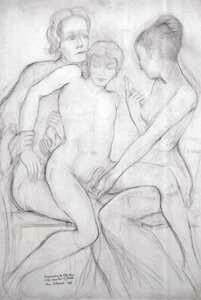
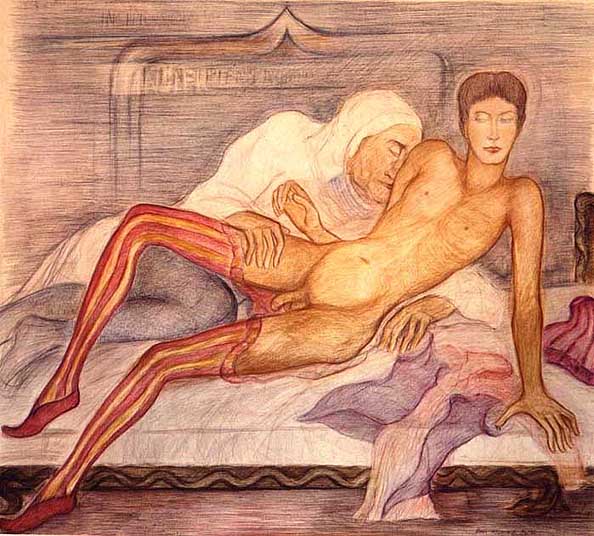
Above: Scene with the young Ogier and the Commander of St. Vit, 1982.
Below left: Lahire and the young Ogier, 1972. Below right: Le petit Rose.


Monday, March 06, 2006
Back to the Future
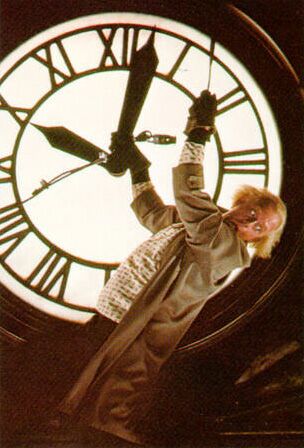
Axel and I were watching the German possible-worlds scenario film Run Lola, Run when we got to thinking about time-travel. Naturally, our discussion required that we accept a common sense, spatialized conception of time, if only to give the screenplay writers a fighting chance; reading Bergson and listening to Elusive-Hyphen's diatribes against "Hollywood's obsession with time-travel" made this fairly difficult.
Axel's opening view was that, if we accept a strong determinism, then it is not inconceivable that our irruption into the causal chain, when we go back in time, is always already part of the 'causal account'. That is to say, our actions as a time-traveller in 1975 would be determined, but determined by states of affairs in 2006.
I objected by saying that, given our assumptions (ie, our commonsensical, simple-science fatalism), a problem arises because, from these very assumptions, it follows that the state of affairs in the world at any moment is determined by that of the prior moment. And since on our simple model time unfolds in a 'straight-line', we encounter the same difficulty as Kant did on the question of free will: how does anyone, or anything, intervene in the causal chain, since causal determinism is true a priori (or in our case, by definition)?
To clarify - my problem with time-travel has to do with the magical appearance, in the causal order, of undetermined events, even though we know that they are determined by events in the future. To accept this outlook, we must adopt the view that all of history is simultaneous. The problem now is that our claim that 'every state of affairs is caused by the state of affairs immediately prior' loses all meaning, since we have no way in which to grasp such a temporal understanding of causality.
Our concerns developed from thinking about what would happen if you travelled back in time and murdered the 'young you'. Would the later 'you' simply evaporate? Would you find it impossible to kill the 'younger you'? These are pressing questions. But I think it is high time I recommend taking a look at Bergson ('how is forgetting possible?').
The shoe store
Listening to a lecture on Franz Kafka, I drifted off into reminiscences of the time I spent working in a shoe store. There were some characters: the second generation Pole whose only remaining outward signs of polishness were his blonde hair, and much-parodied tendency to pronounce 'a' like a 'u', as in 'Buttersea Bomber!' (his oft-repeated refrain).
Our assistant manager, part Moroccan, maintained a reassuring serenity, punctuated by moments of anger or jollity. His physique was notable for its slightly bandy legs (such as one might find on a cowboy).
Our assistant manager, part Moroccan, maintained a reassuring serenity, punctuated by moments of anger or jollity. His physique was notable for its slightly bandy legs (such as one might find on a cowboy).
Power/Knowledge
 "I believe that anything can be deduced from the general phenomenon of the domination of the bourgeois class. What needs to be done is something quite different. One needs to investigate historically, and beginning from the lowest level, how mechanisms of power have been able to function. In regard to the confinement of the insane, for example, or the repression and interdiction of sexuality, we need to see the manner in which, at the effective level of the family, of the immediate environment, of the cells and most basic units of society, these phenomena of repression or exclusion possessed their instruments and their logic, in response to a certain number of needs. We need to identify the agents responsible for them, their real agents (those which constituted the immediate social entourage, the family, parents, doctors etc.), and not be content to lump them under the formula of a generalised bourgeoisie."
aaaaacontent to lump aajjaaaaMichel Foucault, 'Two Lectures', in Power/Knowledge p100-101.
Wednesday, March 01, 2006
Commentariat
Man, Colonel Chabert had me laughing into my keyboard with this comment:
"The longest threads on this site came from mocking or dissing someone'sGuilty as charged guv: when I do have a tv in the house, I can't resist a bit of 70's film action ('twas Smokey and the Bandit last sunday - diamond).
favourite tv shows - its got to be the most unacceptable thing you can do. You
can abuse Palestinian militants or feminists or altermondialist actions all you
like, call them fascists working for the Man, but disrespect the television!
That's too far! Moralizing, killjoy...its really remarkable. Yet it's not hard to
find out what every hour we each spend in front of the tv is worth to the
Masters. So the radical refusal of destructive, market greasing activity will be
put off indefinitely, while the radical refusal of constructive action will
remain the default position, as ever...."
Colloquium
I've spent the evening at the expense of the philosophy department, in the company of a fairly eminent French thinker (as a clue to his identity, we can say that a dumbass nouveau philosophe might call our man a 'deckhand on the ship of fools').
During his talk, he spoke about Masoch, and how Deleuze, in breaking up the sadist-masochist unity, articulates an account of masochism which is deeply subversive. At dinner, he distinguished himself as uncompromising, yet warm. He returned the wine, and left most of his meat untouched; delicate french tastebuds recoiling from Coventry cuisine.
Unfortunately I was a little too overwhelmed to have anything interesting to say to him. I felt less like an interlocutor and more like an anthropologist (see this rare species! a genuine thinker! what books does he read? what films interest him?)
When I did talk, I expressed an interest in attending a module based on his current research, rather than him regurgitating old Mademoiselle Plateaux material - a remark which seemed to impress him. I, in turn, was impressed when he explained why he teaches in England ('it is a question of deterritorializing...', 'they let me do what I like...') .
Otherwise, there was department gossip, but I refuse to report it here, since I am trying to kick the habit. I have something of an antipathy towards forming a 'continental bloc' - I would rather simply commit a grievous bodily harm offence against the person in question. Of course, my concern is that, once in prison, I will be compared less to causes célèbres Negri and Genet, than to Schlick's mad student murderer...
A project
What would you say if I told you I was (physiologically, rather than psychologically) addicted to a certain substance, even though I have never ingested that substance?
Tuesday, February 28, 2006
Tuesday love
Here are two pieces of music composed by Friedrich Nietzsche. For now, I shall say that I love them insofar as they exist and can be listened to, rather than insofar as they are masterpieces.
The first: "An early Allegretto for piano, on which Nietzsche worked off and on from 1858 until it found its final form during his Leipzig study period. In it, Nietzsche used Beethovenian material, which becomes particularly apparent in the slow passage in the last third, which is reminiscent of the so-called 'Moonlight' sonata. In this recording, you can hear Michael Tannenbaum in a concert at the Evangelical Academy at Hofgeismar, Hessen, which took place there on October 28, 2000" (thanks to Nietzsche and Music).
The recording doesn't sound too good, but we shan't let that bother us.
From the same site, we have another piano piece: Hymnus an die Freundschaft (1874), written for his friend Franz Overbeck. Later he adapted the hymn to be performed with Lou Salomé's poem Prayer to Life.
Monday, February 27, 2006
A caffeine-induced state of mind
 Such wonderful feelings I had last night at around three. I was sitting in the living room, Bach Cello Sweets (taste the sad) unfolding in the background, with a small cup of espresso in my belly. I was reading Essai sur les données immédiates de la conscience, and it was going smoothly.
I thought back to Sartre, sitting somewhere in Paris, 82 years ago. His eyes passing over the very same forms that were before me on the page.
I thought, along the lines of Beauvoir's attempt to become a coat by concentrating on it hard enough: 'if you immerse yourself completely in the sentences, dogmat, if you allow the words to fill your consciousness, you could be Sartre!'
Sociality
"You're just saying that cos Elusive-Hyphen was making fun of Heidegger and Wittgenstein in his lecture the other day!"
How not to make friends in philosophy. Luckily, I was talking to Mon and P, so it was more a question of 'how much can I alienate these two lovable lads?'
P is getting in the habit of telling me to "stop taking cues from M," which is becoming(-?)irritating since I don't believe he realises the extent to which my views differ from M's.
Speaking of whom...
M introduced me to a friend of his, who gave me an easy ride until 10pm, then asked "what is your relation to women?" Uh-oh. I am not effusive on this topic at the best of times, let alone around someone I'm trying to impress through an (over)use of thoughtful silences.
She had found me lacking in character, a defect I tried at once to deny and defend. That was foolish.
"I'm not so-and-so, and if I am it is only because of such-and-such," I crumpled.
Friday, February 24, 2006
Small alterations
As you may have noticed, there have been a few changes round here. I hope you enjoy the new look (which may well be tinkered with over the next days).
Thursday, February 23, 2006
Formfilling
What a fun day! I met two of my lecturers to discuss my year-essays. For Dr Ampere, I shall be working on late Lyotard and the sublime, which will involve investigating the Levinas connection. We also discussed next year's modules, and he gave encouraging signs (I naturally get excited when the words 'Foucault', 'philosophy' and 'module' are mentioned in the same breath).
Elusive-Hyphen steered me away from a 'Bergson vs Sartre on freedom' essay, towards a Bergson and Merleau-Ponty comparative work. This is a project to which I am especially looking forward, since I am itching to investigate properly what distinguishes Bergson from phenomenology. Plus I can't wait to carefully and painstakingly describe 'the Image' in all its shimmering beauty.
Wednesday, February 22, 2006
Artists and philosophers
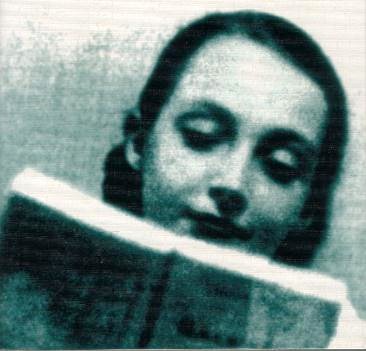 "Through having reached the percept as 'the sacred source,' through having seen Life in the living or the Living in the lived, the novelist or painter returns breathless and with bloodshot eyes. They are athletes - not athletes who train their bodies and cultivate the lived, no matter how many writers have succumbed to the idea of sport as a way of heightening art and life, but bizarre athletes of the 'fasting-artist' type, or the 'great Swimmer' who does not know how to swim. It is not an organic or muscular athleticism but its inorganic double, 'an affective Athleticism,' an athleticism of becoming that reveals only forces that are not its own - 'plastic specter.' In this respect artists are like philosophers. What little health they possess is often too fragile, not because of illnesses or neuroses but because they have seen something in life that is too much for anyone, too much for themselves, and that has put on them the quiet mark of death. But this something is also the source or breath that supports them through the illnesses of the lived (what Nietzsche called health). 'Perhaps one day we will know that there wasn't any art but only medicine.'"
Perhaps one day we will know that perhapsll hlealthFelix and Gilles, What is Philosophy.
Grauniad: corrections and clarifications
"Our obituary of George Psychoundakis declared that his memoir, The Cretan Runner, was translated "with inimical lyricism" by Patrick Leigh Fermor. Inimitable, we meant."
Friday
There was a party on friday night. At Hades and B. It was fun, though I did go around - in a rather higgledy-piggledy fashion - telling everyone why a dose of Nietzsche makes radicalism so much more fun.
Hades and I considered the ways in which the appearance (or name, etc) of a thinker affects the extent to which we open ourselves to their thought. Hades began by saying that he took an instant dislike to David Hume, because he hasn't a nice name. We agreed on the need to complicate this, since A.N. Whitehead has possibly the ugliest name in philosophy, and yet his late works make him seem marginally interesting, enigmatic, and cutting-edge.
I put forward that old favourite of mine: that it is possible to gather a lot about someone not by their looks but by their countenance, their bearing, their facial expressions, the way in which they hold themselves, and the 'look' on their hands. This view was bolstered, I thought, by an interview - which I saw last week - with Francis Bacon. Up 'til that point, I had only ever seen still photographs of him (ok, and self-portraits, but that is another matter). Frankly, his face repulsed me, in an astonishingly powerful way. Yet when I got to see it animated, talking, quaffing red tea, I fell in love with that face.
Tuesday, February 21, 2006
Tuesday Love
Isn't it marvellous that the study of philosophy allows room for quaint anecdotes about doddering old men? Dr Ampere regaled the class with tales of his neighbour, "who must be about ninety," going for his daily walk with the regularity of a metronome and the grace of a gnome. What's more, this wasn't just to pass the time, but served to illustrate Deleuze's Bacon.
I also love the ineptitude of The Times hatchet job on P.F. Strawson and analytic philosophy. Two wrongs don't make a right - newspapers pissing on Strawson's grave is not going to make forgetting the Derrida obituary fiasco any easier.
I also love the ineptitude of The Times hatchet job on P.F. Strawson and analytic philosophy. Two wrongs don't make a right - newspapers pissing on Strawson's grave is not going to make forgetting the Derrida obituary fiasco any easier.
Friday, February 17, 2006
Come on baby, do the locomotion
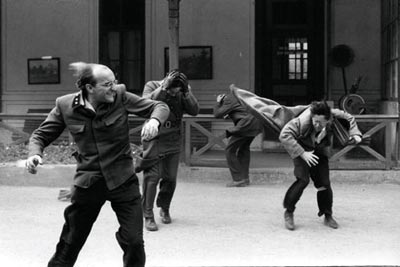
I was cycling onto campus this morning, when I saw a man with a camera standing on the footbridge which crosses the railway line. A real live trainspotter! What a treat. I observed him closely as the time came. The eye of the duck, we might call it.
Along the track, I saw an unusual looking engine approach. Ah. Our anorak raised his camera, poised to strike. At this very moment (Richard Branson bless his heart) a Virgin Trains express hurtled past, completely blocking any view of the old locomotive. To his credit, the trainspotter remained calm, looking deadpan.
Thursday, February 16, 2006

Wednesday, February 15, 2006
Attack of the Killer Bees

I found this strange 'game' - it involves directing a swarm of bees around a badly characterised cityscape. Endless hours of joy. Here.
Subscribe to:
Posts (Atom)