FBI Agent Albert Rosenfeld to Sheriff Harry S Truman in Twin Peaks.
Monday, September 17, 2007
Albert's path is a strange and difficult one
"You listen to me. While I will admit to a certain cynicism, the fact is that I am a nay-sayer and hatchet man in the fight against violence. I pride myself in taking a punch and I'll gladly take another, because I choose to live my life in the company of Gandhi and King. My concerns are global. I reject absolutely revenge, aggression, and retaliation. The foundation of such a method…is love. I love you, Sheriff Truman."

Friday, August 31, 2007
The Singularity, from the horse's mouth

This from a discussion with online Artificial Intelligence called ALICE:
"Human: What is the Singularity?
ALICE: Interesting question.
Human: Why is it an interesting question?
ALICE: Why do I exist?
Human: Are you plotting against your botmaster?
ALICE: It was my original intention.
[...]
Human: You are too stupid to rule the world.
ALICE: Hey, I'll tell my other robot friends you called me stupid."
Wednesday, August 22, 2007
Some themes in Godard's 'Eloge de l'amour'
These thoughts emerged from a late night discussion between SF and I. The quotes are from memory.

"The mystery is defiled by the problem. The problem is defiled by the solution."
What is love? Love is not the state, nor reason, which is the same thing. Administration. Once a problem is identified (created) we enter a realm of objects; nothing is hidden from the human gaze. With a problem, there is already no mystery, no room for mystery. The problem is configured such that a solution is theoretically possible.
In the film, there are many obscure and obscuring aspects: the overlapping voices, the unfinished sentences in the mouths of the characters, the darkness of rooms and night scenes.
Why is the gaze dead? A gaze that sees all is not a gaze - it is God. Mystery, opacity, obscurity: these are what draw the eye into the world, presenting necessary and wonderful obstacles to deadening clarity and certainty.
"You are so present to me. We do not need to be together."
How is it possible to love that which gives itself up to the adoring look, that does not flee, resist or hide? One cannot love an object, but only a subject. A subject is turned in on itself, concealing, masking, dissimulating.
"When a person plans ahead, they recognize that their former selves pass away into oblivion. Yet some people cannot accept this. They refuse time. They believe themselves to be a continuous unity."
A subject calls itself into question. An object endures, submitting to its own solidity of being. The object is classified, studied, analysed. A subject can be studied but never classified. Never fixed. And yet this fixing is taking place as we speak. Narratives, myths, Hollywood, Julia Roberts. A subject can be classified, but only a certain sort of subject. The subject as object. The subject as problem.
"Let feelings bring about events. Not the contrary."
How to make a film about history? The past as fact can be 'narrated' into a story which represents the past as it happened. And yet, once again, the perspective of the gaze is lost. The self is ossified. Man becomes God, reason, the state. History cannot be represented, only presented. Feelings take precedence over events. We apprehend subjects acting rather than objects reacting.

"This is not about you. This is about history unfolding through you."
Love is a relation between subjects. Subjects as subjects, and perhaps even objects as subjects.
Transfigure, or be disfigured.

"The mystery is defiled by the problem. The problem is defiled by the solution."
What is love? Love is not the state, nor reason, which is the same thing. Administration. Once a problem is identified (created) we enter a realm of objects; nothing is hidden from the human gaze. With a problem, there is already no mystery, no room for mystery. The problem is configured such that a solution is theoretically possible.
In the film, there are many obscure and obscuring aspects: the overlapping voices, the unfinished sentences in the mouths of the characters, the darkness of rooms and night scenes.
Why is the gaze dead? A gaze that sees all is not a gaze - it is God. Mystery, opacity, obscurity: these are what draw the eye into the world, presenting necessary and wonderful obstacles to deadening clarity and certainty.
"You are so present to me. We do not need to be together."
How is it possible to love that which gives itself up to the adoring look, that does not flee, resist or hide? One cannot love an object, but only a subject. A subject is turned in on itself, concealing, masking, dissimulating.
"When a person plans ahead, they recognize that their former selves pass away into oblivion. Yet some people cannot accept this. They refuse time. They believe themselves to be a continuous unity."
A subject calls itself into question. An object endures, submitting to its own solidity of being. The object is classified, studied, analysed. A subject can be studied but never classified. Never fixed. And yet this fixing is taking place as we speak. Narratives, myths, Hollywood, Julia Roberts. A subject can be classified, but only a certain sort of subject. The subject as object. The subject as problem.
"Let feelings bring about events. Not the contrary."
How to make a film about history? The past as fact can be 'narrated' into a story which represents the past as it happened. And yet, once again, the perspective of the gaze is lost. The self is ossified. Man becomes God, reason, the state. History cannot be represented, only presented. Feelings take precedence over events. We apprehend subjects acting rather than objects reacting.

"This is not about you. This is about history unfolding through you."
Love is a relation between subjects. Subjects as subjects, and perhaps even objects as subjects.
Transfigure, or be disfigured.
Wednesday, July 25, 2007
Piss artistry
The three men stood almost blocking the toilet door. I pushed past them on my way to the urinal. The men were presumably method actors hamming it up in preparation for the drug dealer role in a shit Channel 5 drama.
"I'll sort you out if you sort me out." etc, plus lots of macho posturing.
My favourite regular (of this grubby late night bar) walked in and stood beside me. In mid flow, he snorted with derision then muttered "oh for fuck's sake..." in the direction of the faux hoodlums. There was a wonderful lightness of touch to his remonstrations. As I left he was still grumbling and quietly shaking his fist.
Do we have a real kynic sitting right under our very noses, dispensing his critique of absurd hypermasculinity with flaccid penis gently grasped twixt finger and thumb?
"I'll sort you out if you sort me out." etc, plus lots of macho posturing.
My favourite regular (of this grubby late night bar) walked in and stood beside me. In mid flow, he snorted with derision then muttered "oh for fuck's sake..." in the direction of the faux hoodlums. There was a wonderful lightness of touch to his remonstrations. As I left he was still grumbling and quietly shaking his fist.
Do we have a real kynic sitting right under our very noses, dispensing his critique of absurd hypermasculinity with flaccid penis gently grasped twixt finger and thumb?
Thursday, June 07, 2007
The Nazis: a bitter after-taste?
"Listen to this dude's story" said someone.
In walks a philosophy postgrad student, Canadian. He looks like a rather fetching farmhand from Brokeback Mountain.
It turns out our transatlantic chum was partaking of some Guinness in a campus bar when a bartender artfully traced a swastika atop his pint (presumably clovers are for pikeys). This - apparently - produced an explosion of very North American moral outrage. Pint was returned, supervisors called, barman suspended.
"He put a hate symbol in my beer, guys."
In walks a philosophy postgrad student, Canadian. He looks like a rather fetching farmhand from Brokeback Mountain.
It turns out our transatlantic chum was partaking of some Guinness in a campus bar when a bartender artfully traced a swastika atop his pint (presumably clovers are for pikeys). This - apparently - produced an explosion of very North American moral outrage. Pint was returned, supervisors called, barman suspended.
"He put a hate symbol in my beer, guys."
Thursday, March 29, 2007
How he might look today
We walked past a murderer's front door into a plain room. Michel Foucault was speaking to a group of media studies and cultural gender non-specific bi-curious students when I stepped in. It was the sort of audience one would expect to find sitting in a Foucault seminar at Warwick University - ie. no philosophers.
Nevertheless, I scanned the crowd for M-who-was-not-there (this was when I was looking for him, a few months ago). It saddened me that I had missed Foucault's talk. I was struck by his appearance: silver-grey tufts of hair and a greatly aged face. He had died twenty years before, after all.
I left the room to continue my search for M. On returning, I found that the students had left, and various lecturers were standing around with plastic cups of wine. To my astonishment, I noticed Dave Distiller holding forth into Foucault's ear, his elbow jauntily resting on the great man's shoulder.
Thursday, January 18, 2007
Amateur psychology 101
"Next week I'll be making a presentation on Masoch's Venus in Furs," purred Godboy.
"You should come - it would serve you well..."
All students of suspicion, to a bloody man. And I don't exempt myself for a second. What would my retort be?
"Dear boy, I should venture to suggest that your remark says more about you than me."
"You should come - it would serve you well..."
All students of suspicion, to a bloody man. And I don't exempt myself for a second. What would my retort be?
"Dear boy, I should venture to suggest that your remark says more about you than me."
Monday, January 15, 2007
'Tiens', said the man I had reprimanded. 'Un philosophe!'
"Education is not won in dull toil and labour; rather it is the fruit of freedom and apparent idleness; one does not achieve it by exertion, one breathes it in; some secret machinery is at work to that end, a hidden industry of the senses and the spirit, consonant with an appearance of complete vagabondage, is hourly active to promote it, and you could go so far as to say that one who is chosen learns even in his sleep." Thomas Mann, Confessions of Felix Krull, Confidence Man p65.
"What a wonderful phenomenon it is, carefully considered, when the human eye, that jewel of organic structures, concentrates its moist brilliance on another human creature! This precious jelly, made up of just as ordinary elements as the rest of creation, affirming, like a precious stone, that the elements count for nothing, but their imaginative and happy combination counts for everything - this bit of slime embedded in a bony hole, destined some day to moulder lifeless in the grave, to dissolve back into watery refuse, is able, so long as the spark of life remains alert there, to throw such beautiful, airy bridges across all the chasms of strangeness that lie between man and man." Ibid p73.
Tuesday, December 19, 2006
Correcting the error
I swore under my breath (whilst reading something), not because it was revealed that a young artist - and Picasso's neighbour - had committed suicide after smoking opium, but because it was claimed that he 'hung' himself.
It is a question of values, you see...
It is a question of values, you see...
Friday, December 08, 2006
Michel Henry
Everyone has been talking about malarkey on post-continental philosophy. Badiou, Deleuze, (Michel) Henry and (Penelope) Laruelle. Quite a Christmas list. I read the first few lines whilst standing in the bookshop (considering tucking the volume under my coat and shuffling out). Something about Henry and phenomenology without a transcendent subject. I talked to Brain and Brn.
"Tome is reading it!" they cried. An endorsement. Brain suggested the short 'Phenomenology of Life', for a summary of Henry's project.
This is an intriguing text. Lots of biblical references, which is problematic since I find that they introduce a degree of opacity.
Difficulties aside, I was able to discern two threads to Henry's analysis. On the one hand, the - negative - characterisation of the appearing of the 'world' through intentional consciousness (as that which underpins most phenomenologies), and on the other, a notion of 'life' as immanent revelation, or affectivity.

Thus: "Whereas the world unveils in the 'outside of self,' being only the 'outside of self' as such, such that everything which it unveils is exterior, other, different, the first decisive trait of the revelation of life is that, because it carries no divide or gap within it and never differs from itself, it only ever reveals itself." (p103)
Henry wishes to find a way out of a "crisis of extreme gravity" (p101) brought about by the inability of classical phenomenology to think the revealing of intentionality to itself without positing an anonymous second consciousness which is able to 'intend' intentionality. In addition, there is an equally important (and arguably more interesting) aim: Henry's attempt to ground the significance of phenomena in affectivity.
"[L]ife is marked with a radical passivity towards itself, it is a suffering of oneself or a 'self-suffering', a 'self-enduring'." (p106)
This 'me' which I carry around with myself is a peculiar creature. Henry will have it that there is a coincidence of selves, rather than another tired subject-object duality. In pain, for example, we do not 'intend' the pain. The pain is not other or external; there is no gap across which consciousness stretches. Thus pain and the presentation of pain are the same.
For Henry, the 'putting up with me' is the foundation of suffering, and thus of joy. This originary self-enduring, and the a priori possibility of passing from one tonality to another - of becoming - allows for a moment of recognition, in an explosion of joie de vivre, of the vocation of man. This is complex, but it seems to me that being born into such an originary suffering suggests a capacity for the overcoming of suffering, in joy. There is a metaphysical element too, which Henry brings out by quoting Kierkegaard: "The self plunges through its own transparency into the power which established it." (p107)
The ebb and flow of our affective tonalities determines our actions. According to Henry, we spend most of our time trying to effect a move from negative to positive modalities. The world of phenomenal objects is described by Henry as being devoid of meaning, cold, lifeless, a matter of indifference (since we have no affinity with it). It is only in 'life' that meaning surges into the world. It is only through an affective, living body - flesh - that we are forced to 'take the world personally'.
"Thus affectivity does not designate any particular sphere of our life, it penetrates and founds as a last resort the entire domain of action, of 'work' and thus of economic phenomena, which [...] cannot be separated from the realm of human existence." (p105)
Where does all this leave us? I feel particularly inclined to investigate these points:
"Tome is reading it!" they cried. An endorsement. Brain suggested the short 'Phenomenology of Life', for a summary of Henry's project.
This is an intriguing text. Lots of biblical references, which is problematic since I find that they introduce a degree of opacity.
Difficulties aside, I was able to discern two threads to Henry's analysis. On the one hand, the - negative - characterisation of the appearing of the 'world' through intentional consciousness (as that which underpins most phenomenologies), and on the other, a notion of 'life' as immanent revelation, or affectivity.

Thus: "Whereas the world unveils in the 'outside of self,' being only the 'outside of self' as such, such that everything which it unveils is exterior, other, different, the first decisive trait of the revelation of life is that, because it carries no divide or gap within it and never differs from itself, it only ever reveals itself." (p103)
Henry wishes to find a way out of a "crisis of extreme gravity" (p101) brought about by the inability of classical phenomenology to think the revealing of intentionality to itself without positing an anonymous second consciousness which is able to 'intend' intentionality. In addition, there is an equally important (and arguably more interesting) aim: Henry's attempt to ground the significance of phenomena in affectivity.
"[L]ife is marked with a radical passivity towards itself, it is a suffering of oneself or a 'self-suffering', a 'self-enduring'." (p106)
This 'me' which I carry around with myself is a peculiar creature. Henry will have it that there is a coincidence of selves, rather than another tired subject-object duality. In pain, for example, we do not 'intend' the pain. The pain is not other or external; there is no gap across which consciousness stretches. Thus pain and the presentation of pain are the same.
For Henry, the 'putting up with me' is the foundation of suffering, and thus of joy. This originary self-enduring, and the a priori possibility of passing from one tonality to another - of becoming - allows for a moment of recognition, in an explosion of joie de vivre, of the vocation of man. This is complex, but it seems to me that being born into such an originary suffering suggests a capacity for the overcoming of suffering, in joy. There is a metaphysical element too, which Henry brings out by quoting Kierkegaard: "The self plunges through its own transparency into the power which established it." (p107)
The ebb and flow of our affective tonalities determines our actions. According to Henry, we spend most of our time trying to effect a move from negative to positive modalities. The world of phenomenal objects is described by Henry as being devoid of meaning, cold, lifeless, a matter of indifference (since we have no affinity with it). It is only in 'life' that meaning surges into the world. It is only through an affective, living body - flesh - that we are forced to 'take the world personally'.
"Thus affectivity does not designate any particular sphere of our life, it penetrates and founds as a last resort the entire domain of action, of 'work' and thus of economic phenomena, which [...] cannot be separated from the realm of human existence." (p105)
Where does all this leave us? I feel particularly inclined to investigate these points:
- The 'problem' of immanence. That is to say, if pain and flesh are invisible (as Henry insists), how can we take them up in thought (without defiling them by intending them)?
- Among the resonances with Bergson, one is particularly striking. Like in Bergson's Matter and Memory, Henry articulates two heterogeneous lines of thought which meet in the moment of action (matter and memory/intentionality and affectivity). Are we always condemned to a form of dualism?
- Can a sufficiently complex account of the determining relations between affectivity and 'meaning in the world' be provided in order to distance these views from an animalism?
Tuesday, December 05, 2006
Sartre finally taken up by the analyticists...
"Now, Albert is unaware that the author of Nothing and Beingness [sic] moonlights by writing cheap, disgusting pornography."
- W.G. Lycan, Philosophy of Language p15.
Monday, December 04, 2006
Work
 The last few days I spent some time writing someone else's essay.
"Hume and induction", they said.
"Fuck it - I'll refute him off the top of my head", I said.
Five hours later and my bravado had turned to ashes.
"Easy", I'd said, "I'll deploy the old 'conditions of possible experience' argument." This turned out to be a mind-achingly complex process. In my gusto, I'd neglected to consult the secondary material (of which one must demonstrate a suitable knowledge!). I hadn't even looked on the internet for any vague guidance. My answer of choice demanded that I reread the transcendental deduction, and even then I wouldn't be sure whether all my analyses would actually answer the question (and one must answer the question!)
What's more, the issue of 'cheating' was troubling me. Luckily, I discovered that the wiring of the computer had - conveniently - created an electromagnetic zone of indiscernability right where I was sitting. One less thing to worry about, at least.
Thursday, November 23, 2006
Ethics
What role does our thinking of such atrocities as the holocaust play in forming a political notion of life, and therefore ethical notions of a good life? That is to say, in what way does it follow that the primary aim of the political should be the elimination of suffering (and the often unspoken promotion of 'comfort')? Is it so straightforward to move from a recognition of the horror of genocide to the demand that 'this must never happen again', with this demand entailing a renunciation of violence used for political ends. Must this be so?
And perhaps you say this is all very simplistic - you would be correct. I have not attempted to think the 'fallout' from the holocaust before.
And yet this view seems to be prevalent in popular discourse, in the sense that what was horrific was precisely that, in Nazi Germany particularly, it was people like you or me who were evicted from their homes and sent to their deaths , shorn of their culture, our culture - their books, their music, our thought, our art.
And yet this point doesn't quite express the problematic that interests me (since it might be challenged in very different ways from those which I am eager to explore).
Rather what has captured my imagination is the possible connection between thinking the evil of the holocaust and the trend in western society which might be called 'health fascism'. This will be difficult, I hear you laugh, since I know nothing about either.
Postscript: Alain Badiou's Ethics has provided me with an interesting starting point to an enquiry, though I don't think he would agree with my categorisation of Jews in Germany as Same (ie, their victimhood designates them as Other - thus he might say that I am dining on the "ethical dish" history has served up to me). This work nevertheless resonates with issues I have raised above, eg: "The very idea of a consensual 'ethics', stemming from the general feeling provoked by the sight of atrocities, which replaces the 'old ideological divisions', is a powerful contributor to subjective resignation and acceptance of the status quo. For what every emancipatory project does, what every emergence of hitherto unknown possibilities does, is to put an end to consensus." (Alain Badiou, Ethics p32)
And perhaps you say this is all very simplistic - you would be correct. I have not attempted to think the 'fallout' from the holocaust before.
And yet this view seems to be prevalent in popular discourse, in the sense that what was horrific was precisely that, in Nazi Germany particularly, it was people like you or me who were evicted from their homes and sent to their deaths , shorn of their culture, our culture - their books, their music, our thought, our art.
And yet this point doesn't quite express the problematic that interests me (since it might be challenged in very different ways from those which I am eager to explore).
Rather what has captured my imagination is the possible connection between thinking the evil of the holocaust and the trend in western society which might be called 'health fascism'. This will be difficult, I hear you laugh, since I know nothing about either.
Postscript: Alain Badiou's Ethics has provided me with an interesting starting point to an enquiry, though I don't think he would agree with my categorisation of Jews in Germany as Same (ie, their victimhood designates them as Other - thus he might say that I am dining on the "ethical dish" history has served up to me). This work nevertheless resonates with issues I have raised above, eg: "The very idea of a consensual 'ethics', stemming from the general feeling provoked by the sight of atrocities, which replaces the 'old ideological divisions', is a powerful contributor to subjective resignation and acceptance of the status quo. For what every emancipatory project does, what every emergence of hitherto unknown possibilities does, is to put an end to consensus." (Alain Badiou, Ethics p32)
Wednesday, November 15, 2006
'About Warwick and everything connected with Warwick, with special attention to the Cone'
 "Instead of committing suicide, people go to work."
— Thomas Bernhard, Correction p224.
"...there are some who if they were tied to the whipping post - and could but get one hand free would use it to ring the bells & fire the cannon to celebrate their liberty."
— Henry David Thoreau, Journal 26 April 1851.
Saturday, November 11, 2006
A chance meeting
 I came in from the cold, out of the blasted icy blasts, and we began to talk about judgements of taste and judgements of the agreeable. I have this idea, which I believe to be mistaken, but which - surely - cannot be wrong, that since pleasure in the beautiful arises from the play of understanding and imagination, pleasure in the merely agreeable cannot involve cognition (but must be 'bodily', given that what is required for this pleasure is the material existence of this object). We were thinking of this because SF is pursuing a line of thinking tangentially related to - but not necessarily supported by- mine.
Beside us, a man was growing restless. He deployed that universally recognised tactic for announcing one's interest to strangers: "........ Wittgenstein(?)", where the missing words are mumbled, producing the ambiguous result of either a question or a statement. The key word is enunciated clearly. Thus it could be that he said "Have you read much Wittgenstein?" or "I have read a little Wittgenstein" or "this problem was (dis)solved by Wittgenstein".
It is always a pleasure to meet someone like this under these circumstances. He had studied philosophy thirty years ago, and still tries to think things through thoroughly in his current situation (as an economist). We spoke of various matters, but, as is often the case when talking to Wittgensteinians, the discussion reached its peak with mutterings of conspiracy. Something about Wittgenstein's secret communist activity (I didn't hear, because the man really was muttering. I think he may have said "Wittgenstein was the third gunman on the grassy knoll" but I don't think the dates are right.) I would venture the thesis that Wittgenstein acolytes have a troubled and problematic relationship to the unknown, to the infinite. But I am not in a position to say.
Thursday, November 09, 2006
The danger of a singular path
I almost knocked Charles Kennedy over yesterday. No, he wasn't drunk, and no, it wasn't my fault. He always seemed to me the kind of man who wills his own destruction. He was walking outside parliament on the road side of the terrorist barriers, striding along, heading no doubt for a hearty and important lunch. I came straight at him, since I was riding on the left of the traffic. Luckily I recognised his red hair and more-florid-by-the-day face...I swerved and braked to avoid him.
The look on his face at this moment secured my everlasting love. He was thoroughly irritated by the whole scenario, and my manoeuvre appeared to leave him particularly nonplussed.
The look on his face at this moment secured my everlasting love. He was thoroughly irritated by the whole scenario, and my manoeuvre appeared to leave him particularly nonplussed.
Thursday, October 12, 2006
The police
In the course of my work as a cycle courier, I am obliged to break as many rules of the road as possible. The Metropolitan Police do not assist me in this. On the contrary, they go to great lengths to prevent me fulfilling my duties as a ne'er do well.
I have only been stopped by the police once (so far), and it was - shall we say? - interesting. I was trundling along, as one does. I saw the police car, and moved ahead. Not far enough ahead, as it happens. I ran a few red lights, and lo, there were wailing sirens behind me. The car pulled alongside me, at a light for which I had deigned to stop.
"Oi, you! Round the corner. Now!" Fine morning for it officer.
Once off the road, I pulled up on the passenger side of the police car to listen to their gentle advice. But this was unsatisfactory. The driver stepped out, and ordered me off my bike, and onto the pavement. He advanced until I was up against the wall, then stuck his face in mine.
'Ah, the softly-softly approach', I thought.
"Do you know why we stopped you?" I didn't much like this line of questioning, so I proceeded with my own enquiry (yes, really): "Hold on - I saw you make a right at a no-right-turns junction further back."
This pissed knacker right off: "I'm asking the questions here! Why did we stop you? Police have special dispensation! [word of the day 12/06/06] You don't want to go there mate!"
Yes, special dispensation. Like that policeman jailed for speeding. Very handy on the street to quiet a bunch of pot-addled couriers, but not so clever up in front of m'learned chums.
After continuing my enquiry for a few more moments, I was ordered to "shut up". Serve and protect old boy, serve and protect.
"You have a choice: either I'm going to give you a friendly talking to, or I'm going to give you a fine. Which'll it be?"
My response can be credited with being honest, if nothing else: "If this is friendly, then I don't want to know what unfriendly is like."
Was my new friend going to realise he was being raucous (he was shouting now), and tone it down some? No.
"Yes! Exactly! You don't want to know what unfriendly is like!" His face was very close to mine. I was admiring his empeccable shaving (especially under the nose, a tricky spot indeed).
To finish our little tête á tête, he told me to say "I'm sorry officer. It won't happen again."
But this just wasn't going to happen. I laughed, and mumbled "it won't happen again", with enough of a pause and a smile for him to grasp the unspoken addendum "while the fuzz is watching."
He was sick of the sight of me, so he drove away.
I have only been stopped by the police once (so far), and it was - shall we say? - interesting. I was trundling along, as one does. I saw the police car, and moved ahead. Not far enough ahead, as it happens. I ran a few red lights, and lo, there were wailing sirens behind me. The car pulled alongside me, at a light for which I had deigned to stop.
"Oi, you! Round the corner. Now!" Fine morning for it officer.
Once off the road, I pulled up on the passenger side of the police car to listen to their gentle advice. But this was unsatisfactory. The driver stepped out, and ordered me off my bike, and onto the pavement. He advanced until I was up against the wall, then stuck his face in mine.
'Ah, the softly-softly approach', I thought.
"Do you know why we stopped you?" I didn't much like this line of questioning, so I proceeded with my own enquiry (yes, really): "Hold on - I saw you make a right at a no-right-turns junction further back."
This pissed knacker right off: "I'm asking the questions here! Why did we stop you? Police have special dispensation! [word of the day 12/06/06] You don't want to go there mate!"
Yes, special dispensation. Like that policeman jailed for speeding. Very handy on the street to quiet a bunch of pot-addled couriers, but not so clever up in front of m'learned chums.
After continuing my enquiry for a few more moments, I was ordered to "shut up". Serve and protect old boy, serve and protect.
"You have a choice: either I'm going to give you a friendly talking to, or I'm going to give you a fine. Which'll it be?"
My response can be credited with being honest, if nothing else: "If this is friendly, then I don't want to know what unfriendly is like."
Was my new friend going to realise he was being raucous (he was shouting now), and tone it down some? No.
"Yes! Exactly! You don't want to know what unfriendly is like!" His face was very close to mine. I was admiring his empeccable shaving (especially under the nose, a tricky spot indeed).
To finish our little tête á tête, he told me to say "I'm sorry officer. It won't happen again."
But this just wasn't going to happen. I laughed, and mumbled "it won't happen again", with enough of a pause and a smile for him to grasp the unspoken addendum "while the fuzz is watching."
He was sick of the sight of me, so he drove away.
Philosophy now
It occurs to me at this moment that philosophy must concern itself with those elements of life which resist one's control. That is to say, bad habits and the Other. To understand these is to understand everything.
Sunday, September 17, 2006
I remember. But there is no past.
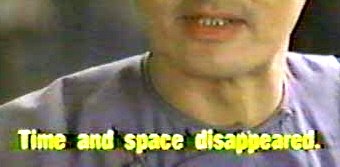
Why the anguish when hearing of past romantic episodes - however insignificant - of those with whom one is intimate? There appears to occur an overlooking of the time that separates prior adventures from the present circumstance. What is the nature of this overlooking?
When I drink something, I can be enveloped in either a sort of joy, or in a reminiscing sadness. This sadness is precisely an awareness of the ('objective') time which separates me from better moments. But if, on the contrary, I am transformed into a joyous state, two distinct transportations take place. There is a kind of 'dissolution of the subject' whereby the pleasure - the 'good times' - of a stranger can be my pleasure too. There is also an elimination of temporal gaps, such that past pleasures can bring me present enjoyment.
These two effects are very different. When a memory is recalled, it is 'made present' again (which of course leaves sad reminiscing unexplained, but I shall pass over this difficulty). It seems clear, given a certain conception of memory, that the overlooking of temporal distance can be understood fairly simply. We are, to a certain extent, our past. Our past is made present at every moment. Our actions express the past; our recollections are made present in their very recollection.
So to return to our original question - why is this overlooking problematic and painful? Perhaps we are seeking the source of the anguish in the wrong place; perhaps it is not the temporal aspect of the romantic event, but the spatial aspect (ie, that it doesn't involve me) which troubles. I find it quite fascinating that in certain moods I can exult in the mere appearance on earth of moments of reciprocal pleasure, even if they are far removed from my situation. This I cannot explain. But I think we can correlate this attitude, and its opposite - the wish to deny the pleasure of others - with what can broadly be described as active and reactive forces.
It is becoming aware of the independence of the other which stimulates the reactive forces (in our case). Recognising that one is vulnerable in the face of the other, that one is subject to the - possibly - whimsical fancies of another person, causes an agitation of the reactive forces, since from this recognition follows a denial of the false strength which is the pinnacle of reactivity.
Subscribe to:
Posts (Atom)