Tuesday, January 17, 2006

The Book of Pleasures

Last night, over the course of four hours continuous reading, I discovered Raoul Vaneigem:

"Sabotage, absenteeism, voluntary unemployment, riots, wildcat strikes, stealing for fun and doing things for the hell of it - the axe is laid to the commercial tree and I'm delighted. As sure as work kills pleasure, pleasure kills work. If you are not resigned to dying of disgust, then you will be happy enough to rid your life of the odious need to work, to give orders (and obey them), to lose and to win, to keep up appearances, and to judge and be judged.”
The Book of Pleasures, p20.

"To drink, insatiably thirsty, at the 'cup of life' is the best guarantee of its never running dry. Children know it - they take everything as if it were an unlooked-for present. Lively senses make their world live, long before the economic imperative starts totting the bills run up by life; before they learn about reciprocity; before they set out to deserve their presents, demand their due, be rewarded for winning, or punished for a depreciation, or thank those who remove one by one the charms of an existence without opposition." Ibid. p38.

"Women have long shared with artists, children and madmen the privilege of shrieking, singing, weeping, throwing their arms about, offering any old thing in gift, and betraying what is usually kept quiet. Since industrialisation won them the priceless right to work in a factory, gain a wage, run a business and command an airborne division - while artists became civil servants and promoted culture - only children and the so-called mentally ill are left to give confused expression to the convolutions of language prised from the grip of trade." Ibid. p48.

"If someone strikes me on my left cheek, I will smack him in the teeth sooner than offer him my right. Is not my enemy whoever constrains me, threatens me or makes me feel guilty? I want to live what I specifically am, without norms and without always watching for someone waiting for me at the corner of the street. If I kill what represses me, it will be inadvertantly, as I stride out happily, without looking back." Ibid. p65

"Nothing is passionately interesting if you are counting the pennies or feel forced to do it. Only desire teaches us to live. You hear people all to often weigh their words and pause for you to admire profundity. Desire, on the other hand, leaves everyone to work out his own way in silence." Ibid. p92.

Monday, January 16, 2006

More mischievous troublemaking


"Foucault said once that with Deleuze philosophy became theatre. Well, with the English Deleuzeans it becomes circus. Philosophy for clowns."
So M.arc opens the comments to my previous post. Golly, dogmat has never seen so much activity!
Clowns, eh? Those sad, determined faces. There is no lightness, no real joy to be found in the circus - a heavy, frightening place filled with jeering laughter.

"...hope it is not going to go Nick Landish again…" whistles the anonymous Jean X, (the cadence of the passage suggests a certain regular commentator). Nope, I don't think it will. Nick Land and his 'movement' seem, with bleary hindsight, to have been able to laugh at themselves. With the new "Deleuzean mafias" (such a snappy catch-all phrase: thanks, Marc), I'm not sure fun poking is permitted.

Often I find myself fielding questions about whether I shall be taking part in this or that reading group or seminar. I tell my friends, "I am not interested in becoming a Deleuzian along with everyone else. I want to engage with him seriously when I am ready; and I am not ready." Their eyes cloud over with suspicion and concern. Someone brandishes a text at me, another lays a threatening/forgiving hand on my shoulder. Do I want my academic career to sleep with the fishes?

Friday, January 13, 2006

Rebels D&G: now the fashionable orthodoxy?

I'm talking about Deleuze and Guattari™

I was sitting peacefully in Raffles yesterday, reading Wittgenstein's Nephew (Thomas Bernhard), when two people sat down next to me. Mr O started to talk. His voice could only be described as the voice of someone who knows.
"Thousand Plateaus is a work of...[inaudible]...,"
He then tried to address his interlocutor's concern about the contents page:
"...transversality of concepts, you see..."
The hapless student tried to drag the discussion on to familiar territory - a novel he'd lately read involving 'virtual-something'. Big mistake, friend.
Mr O swept aside this impoverishment with a short speech about the difference between the possible and the virtual (I hope this is right - I am writing from memory, and my shameful ignorance isn't helping.)
The momentum built up during three minutes of continuous talking made him almost unstoppable:
"...Deleuze and Guattari™ are only interested in the aesthetics of composition..."
He didn't say "...my dear boy," but he could have.

Mr O has adopted the attitude of the expert. He has reached that point in his intellectual development where he is permitted to drop the hesitancy, and the tentative sounding remarks. He stops thinking for himself, but now has a duty to think for others. His role is pedagogical.
I took an immediate dislike to him.

Tuesday, January 10, 2006

The malady of the yes-sayer

A friend is ill. I am back in damp dark dank midlands. I don't feel like posting anything. "Looking away shall be my only negation."

Monday, January 09, 2006

Saturday, January 07, 2006

Thursday, January 05, 2006

Is this a meme?

1. What did you do in 2005 that you'd never done before?
I began to write (essays, blog, etc) more regularly.

2. Did you keep your new years' resolutions, and will you make more for next year?
My new new year's resolution is below. I should also say that I don't want to put anything more on this blog about academic philosophy politics in 2006. I am not a gossip columnist.
I didn't have any resolutions last year.

3. Did anyone close to you give birth? No.

4. Did anyone close to you die? No.

5. What countries did you visit? Sweden and South Africa.

6. What would you like to have in 2006 that you lacked in 2005? Excitement about returning to London to earn a living.

7. What date from 2005 will remain etched upon your memory, and why? None in particular.

8. What was your biggest achievement of the year? There wasn't any single achievement. I did one or two things which I am reasonably pleased about.

9. What was your biggest failure? Not working as hard at philosophy as I know I should've.

10. Did you suffer illness or injury? No.

11. What was the best thing you bought?
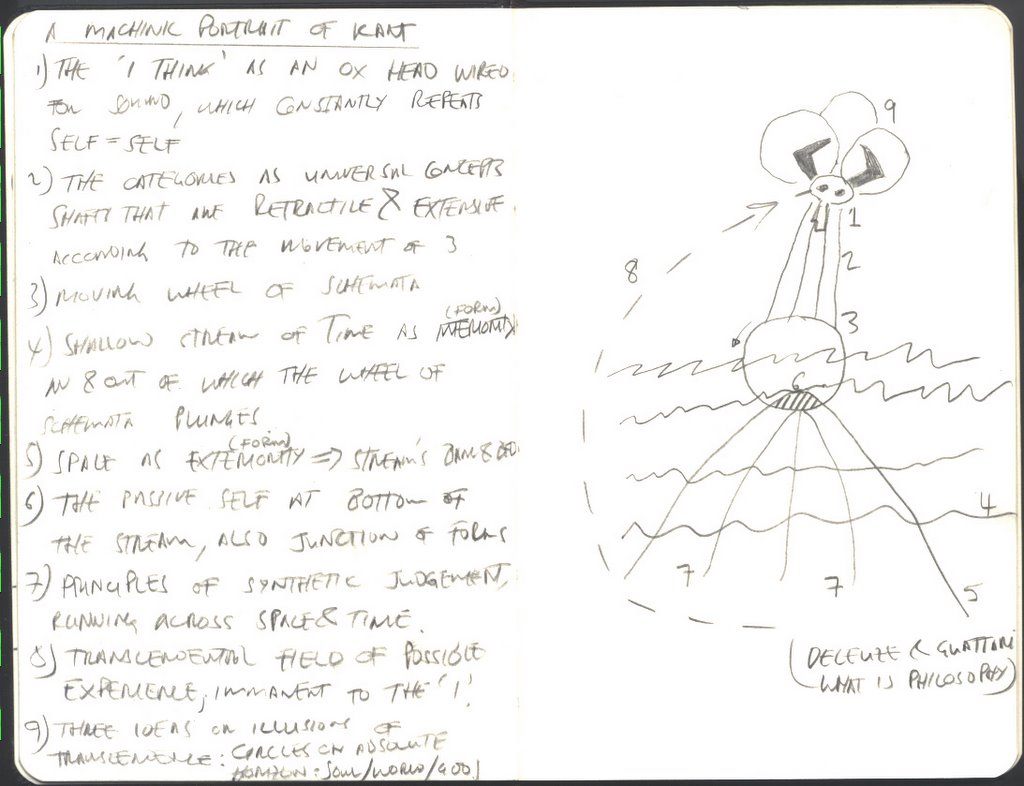
A book - probably Kant's Critique of Pure Reason. It was whilst reading this that I felt for the first time that I was being serious about thinking.

12. Whose behavior merited celebration? My brother's. He returned to school this year.

13. Whose behavior made you appalled and depressed? Ha! There are so many names.

14. Where did most of your money go? Coffee and fish-fingers.

15. What did you get really, really, really excited about? Kant, Merleau-Ponty, Nietzsche, and (obviously, I hope) in a different way, New Orleans.

16. What song will always remind you of 2005? Bob Dylan's Maggie's Farm, just cos my Dad and my little sister got hooked on it over the holidays.

17. Compared to this time last year, I am... less interested in taking my own life.

18. What do you wish you'd done more of? I wish I'd tried a little harder to connect with people, especially strangers.

19. What do you wish you'd done less of? I could have done with less fatuous grumbling.

20. How will you be spending Christmas? With family in a town in the middle of South Africa, eating lebanese food.

21. Did you fall in love in 2005? I couldn't say.

22. How many one-night stands? Hmm, let's just say that my mind (and my body) doesn't function in a way that is conducive to drunken sex with strangers.

23. What was your favorite TV program? I was introduced to Arrested Development by my housemate Axel.

24. Do you hate anyone now that you didn't hate this time last year? Not really. Hatred, for me, is a fleeting emotion.

25. What was the best book you read? Tough. Two books which really opened up my thinking were Henri Lefebvre's Rhythmanalysis and Nietzsche's Gay Science. Another marvel was Thomas Bernhard's Concrete, which M recommended me.

26. What was your greatest musical discovery? There were quite a few. Jimi Hendrix and Bob Dylan, so far as pop music goes. Charlie Chaplin's compositions, which provide the soundtracks to his films, were a treat (the music for The Circus - what beauty!). Plus 'live' classical music; something which I have never really enjoyed before.

27. What did you want and get? An education.

28. What did you want and not get? An education.

29. What was your favorite film of this year? I've not seen many new releases. The best film I saw for the first time was possibly Renoir's La Regle du Jeu.

30. What did you do on your birthday, and how old were you?
I spent the time with my mother in London, I think.

32.What one thing would have made your year immeasurably more satisfying? More reading.

33. How would you describe your personal fashion concept in 2005? Second-hand (including shoes, excluding underthings). Style never goes out of fashion and all that...

34. What kept you sane? Talking to close friends.

35. Which celebrity/public figure did you fancy the most? I found Judith Butler more than a little attractive. And then there was Alcibiades, in Plato's Symposium.

36. What political issue stirred you the most? I surprised to find that my warped weltanschauung was given credence by the events in New Orleans and Iraq.

37. Who did you miss? Various family members. My colleagues from the last job I had before taking up philosophy study full-time.

38. Who was the best new person you met? Brn.

39. Tell us a valuable life lesson you learned in 2005. Fuck that for a game of eggy soldiers.

With gracious thanks to Fort Kant.

Saturday, December 31, 2005

For the new year

"I still live, I still think: I still have to live, for I still have to think. Sum ergo cogito: cogito, ergo sum. Today everybody permits himself the expression of his wish and his dearest thought; hence I, too, shall say what it is that I wish from myself today, and what was the first thought to run across my heart this year - what thought shall be for me the reason, warranty, and sweetness of my life henceforth. I want to learn more and more to see as beautiful what is necessary in things; then I shall be one of those who make things beautiful. Amor fati: let that be my love henceforth! I do not want to wage war against what is ugly. I do not want to accuse; I do not even want to accuse those who accuse. Looking away shall be my only negation. And all in all and on the whole: some day I wish to be only a Yes-sayer." - Friedrich Nietzsche, The Gay Science.

Thursday, December 29, 2005


'Yass yes yes...' he said, rubbing his belly.

Tuesday, December 27, 2005

'Segregation? Not since 1994...'

My father and I gave a lift to two men who work at the house where we were staying. We took them to their home, a township 30 miles outside Bloemfontein called Botshabelo.
Sam and Willem, father and son, tend the vegetables in addition to working for a furniture restoration business. They are employed by my step-mother's father, an imposing man who on first impression bears out Nietzsche's claim that "anyone with a very loud voice is almost incapable of thinking subtleties." He is, on the contrary, however, a complex and interesting man who overflows with generosity, hypnotic power, and booming laughter.

On arrival at Sam's house, he introduced us to his wife, and showed us around. It was hot, since there was no ceiling - only an asbestos roof; but the house did have electricity and running water, which is something of an advancement.
Botshabelo, we discovered, is a town of its own, with a shopping centre and different districts. Two things distinguish it from any 'normal' town - there are not street and area names, but codes made up of numbers and letters (Sam's home is in K section). Secondly, in the hour and a half that we spent there, I saw only one white person, a farmer driving in his car.
The apartheid planners left quite a legacy. Botshabelo, which began as a settlement for those forcibly removed from more rural areas, is too far from Bloemfontein to attract anyone else to live there. In the 'new' South Africa, it is (slightly) more possible for black men and women to lift themselves out of township poverty, but there seems to be little likelihood that a town such as Botshabelo ever develops into a vibrant and diverse place to live. This is very unfortunate, since it has a certain good character. As is the way in this wretched country however, my father and I were warned not to get out of the car, lest the 'dark hordes' have their way with us. Foolish nonsense! (which, I am coming to realize, is not so harmless as all that.)
After unloading Sam's bags, we headed over to meet his brother, who runs a small liquor store from his house. He invited us into his living room for a beer (in fact, we initially invited ourselves, because of a mix up which involved my father mistakenly thinking we were in an illegal drinking establishment). Nonetheless, we all sat down and talked, about local football (Kaizer Chiefs is the name of a club as well as a band) and morogo, a food made from potato and spinach.

Wednesday, December 21, 2005

Bloemfontein

My South African odyssey has taken me to Bloemfontein, a large town in Free State province. It is a relaxing place for me, because I do not know it well, and it does not know me well. I am freed from the wealthy middle-class rut of my home town.
Yesterday afternoon, I took a long walk on the wide, dry boulevards. I had been given directions, but I decided this time to get the 'conditions of possibility' to work for me. It is a condition of possibility of a planned walk that the route be deviated from (if this were not the case, it would mean that I could walk in any direction and still get home). Deviate I did, into some rather rundown districts; you know you are getting to the interesting parts of a town when sex-shops begin to appear. I saw very poor white men, an unusual experience even now. They have very tanned skin, which contrasts with their sun-bleached blonde hair. There is a broken look in their eyes.

Stumbling along the hard shoulder, I found a chess piece in the gutter - a rook, or castle. The castle symbolizes Bloemfontein well. The white, afrikaans speaking community here is a bastion of the old values of apartheid. This is a place where men are men, women are not much at all, and body-building supplements have a prominent place in every supermarket. On the other hand, black Sotho-speakers make up 90% of the population here, and since the fall of the old regime, they have come to occupy almost all the important regional government posts. A castle, we may note, doesn't change hands by degree - it is held either totally, or not at all.

Ants

I see two ants crawling - walking - towards one another. They meet and pause for a few moments, perhaps slightly longer than usual. How do I interpret, or understand, this?
Were I to see two humans meet, I would speculate about whether they know each other, are old friends, etc, depending on how long they remain together (if they are too distant to for me to see gestures and hear voices). With the ants, I cannot posit any self-awareness. Even if the ant has some sort of information, or message, to convey, I must think of this in purely functionalist terms. The ant has not been given a task - rather, this is simply something that ants do. And this in turn must be conceived instinctually. Can we make an analogy with breathing, or the beating of the heart? Or would this conception force us to consider an ant colony as a single organism (and if so, what is the problem with this)?

Monday, December 12, 2005

Report from South Africa III: the long goodbye

Leaving my house in Coventry at 3am presented two main dangers: rain, and drunken revellers. Rain threatened, and drunken revellers impressed me with their cogency.

"What are you doing with a suitcase at this time of night?" asked a girl, who felt that I was more interesting than the argument that she was having with her boyfriend. Before I could respond, she squealed "you're getting married, aren't you?!"
Smiling no, I withdrew.

Report from South Africa II: the good old days

To atone for my previous post - an ill tempered diatribe - I present a selection of 'humourous' excerpts from apartheid discourse.

We do not believe that the Native is really a communist at heart. He is not able to form a conception of the ideology and of the dialectical materialism of their doctrine. - Dr N Diederichs, House of Assembly, 1948.
A large proportion of your Natives today are still savages, others are semi-civilized, others are more or less civilized. - Minister of Justice, 1959.
In the past the torch of civilization had been kept burning in the country because "among other things our forefathers were such good shots." - Minister of Defence, 1961.

Mata Buela, 36, was fined R30 (or two months) this week, for stealing a banana. The value of the banana was placed at one cent. It was his first conviction. - Newspaper report, 1961.

At least ten people have now died in Mamelodi since yesterday morning, according to unconfirmed reports. The figure is expected to rise after police have completed their investigations. - Newpaper report, 1985.

A 13-year-old African babysitter appeared in court on a charge of assault because he hugged a white child in his charge. He had knelt down and opened his arms, and the little girl had run to him and they had hugged. - Newspaper report, 1985.

I don't think I need add anything to this, except perhaps the words "scott free?"

Friday, December 09, 2005

Report from South Africa I: Hegel

I am on holiday in Cape Town. I should like to say one or two things about what we might call the 'situation' here. That is not to say, the political situation. Rather, the situation in general.

I am already fed up with the tiresome fawning of people working in the service industry. Buying a coffee, for example, feels more like an encounter with some deluded supplicant: the customer is a deity, whose every wish is granted. The waiter/shop assistant clings to the customer like a cheap suit.

This creates a rather problematic relationship, which Hegel understood particularly well. People here - South Africa - expect to be treated like royalty when in a shop or restaurant. Staff duly oblige ('you are dispensable - there are ten people who would happily take your place here'). But we cannot help but ask: what kind of esteem is this?
'I am a king - see how they treat me!'
The 'they' is elusive, like Hegel's subhuman slave.
Who could truly value the worship of these coerced, subservient wretches? Only a bunch of deluded fools. The kind of deluded fools who could convince themselves that apartheid is right and good, perhaps? Well, we needn't go that far. Yet.

The spirit of apartheid is still very much alive. I must emphasize, however, that I am not only talking about black service staff. The same lamentable self-abasement is demonstrated by white student jobbers, and shopkeepers.
The petty desire for wielding power over others, which was a condition of possibility for apartheid, is now satisfied by our 'legitimate' capitalist regime.
'I don't care whether he is black or white - I want him to lick my boots because I have paid for the privilege!'

Monday, December 05, 2005

Rousing rhetoric or messianic twaddle?

'Gentlemen' he said,
I don't need your organisation,
I've shined your shoes,
I've moved your mountains and marked your cards,
But Eden is burning,
Either get ready for elimination,
Or else your hearts must have the courage for the changing of the guards.
nnnnnnnnnnnnn nnnn- Bob Dylan, Changing of the Guards

Dogmat circulates

O end of term dilemmas! Which party to go to? In the final analysis, I chose the path of least resistance: Matches' birthday bash. I gave him a rather fetching old copy of short stories by Bertrand Russell, a suitable gift for the continentally challenged.

After a thoroughly useless Saturday, I thought that a quiet spot of red tea would do the world of good. And it did. I had a few interesting talks with people. My opening gambit of the evening was "if you had to choose between a person getting killed, or the Mona Lisa being destroyed, which would you go for?" This was a discussion that I had been having during the day, with Lila, Axel, and, later, Brn. Does it sound like a piece of philosophical impoverishment? Yes, well, ole Danny Dennett talks about it somewhere in one of his popular science works (the book just happened to fall open on this - obviously well thumbed - page while Axel was perusing it), and it certainly has all the hallmarks of an irritating Anglo-Saxon thought experiment. And yet...

I also had the good luck to chat to a Norwegian physics student, who gracefully explained what Wave-Particle Duality means, why the sky is blue, what a quantum computer can do (and why), and how a hologram works. What's more, he enjoyed it, unlike the last physics student I happened upon at a party, whom I coerced into explaining the theory of relativity, with diagrams, equations - the works.

As nights draw in, academic gossip intensifies. Glueboot emailed me the other day, to tell me that our new VC (who'll be replacing Marty Vanderpoot) has written on Deleuze and Virilio. Maybe we can wonder how much he can have learnt from these thinkers considering that he is now an administrative bigwig, but maybe that isn't necessary - it is good news all the same.
I also heard a piece of broken telephone speculation which seems so unbelievable that it would be irresponsible to reproduce it here...
A Baudrillardian friend told me that he was told that Professor Elusive-Hyphen wrote an email to every member of our philosophy department saying simply: "If you want all the Continental philosophers to leave, just say so."
Even if this tale isn't true, or has been distorted beyond recognition, I want to believe it. I find it comforting to know that at least one of my teachers has some cojones. Dammit!

Later, I had been trying to describe the difference between Sartre and Merleau-Ponty to a Wittgensteinian pal, when we were interrupted by someone drunkenly frolicking.
When we resumed our discussion, he said: "What were we talking about again? Oh yeah, Wittgenstein..."
No, we were actually talking about phenomenology you fuckwit.

Hup hup. Forty-two! Sixty-seven! Go long!

American Football is such a strange sport. Like the way that the game is broken up endlessly, and the time between plays filled with studio analysts' inane drivel. They waffle about taxicab problems, or how much money they have bet on the game. When they think that play is about to begin, they cross over to the US commentators, who are picked up mid-sentence, so all the viewer hears is gruff laughter followed by "that's right John..., now back to the action."
And they say cricket is odd.

Friday, December 02, 2005

Google Maps

What an innovation - here is an image of the neighbourhood where I grew up (my house is in the centre). And note that it is possible to zoom-in still further, for extreme detail.